
Headache Patterns and What They Can Signal

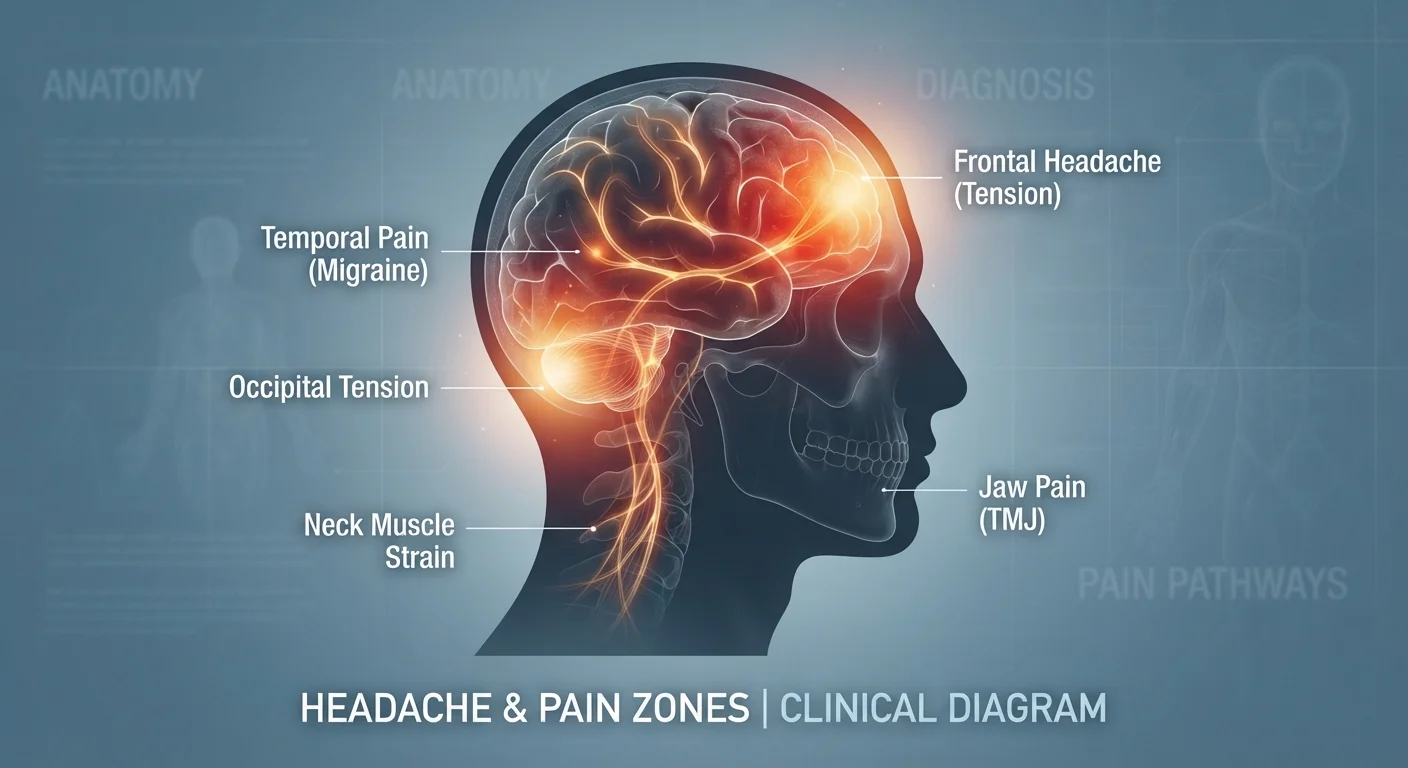
Photo: HerbHealWellness.com | Modern Guide To Wellness editorial
Why Headache Patterns Matter
Not all headaches are created equal. Where you feel pain, how it behaves, and what accompanies it are all meaningful details that clinicians use to distinguish one headache type from another. Learning to describe your headaches accurately — their location, onset, intensity, and duration — helps your healthcare provider arrive at a more precise assessment.
This reference guide covers the most common headache patterns and what each may suggest. It is general health information, not a substitute for professional evaluation. If you experience headaches that are sudden, severe, or accompanied by neurological symptoms, seek medical attention promptly.
| Most common type | Tension-type headache (World Health Organization) |
| Migraine prevalence (US) | ~15% of the population (American Migraine Foundation) |
| Cluster headache prevalence | Affects fewer than 1 in 1,000 people (National Institute of Neurological Disorders and Stroke) |
| Headache-free after identifying triggers | Varies significantly by individual |
| Red-flag symptom: sudden severe onset | "Thunderclap" headache requires immediate evaluation (American Academy of Neurology) |
Common Headache Types at a Glance
Understanding the distinct features of each headache type is the fastest way to communicate your experience clearly to a doctor.
Tension-type headache
The most common headache type, characterized by a dull, pressing or tightening sensation — often described as a band around the head. Usually bilateral and not worsened by routine physical activity.
Migraine
A neurological condition producing moderate-to-severe, often one-sided, throbbing head pain lasting 4–72 hours. Frequently accompanied by nausea, vomiting, and sensitivity to light or sound.
Cluster headache
An intensely painful headache occurring in cyclical episodes (clusters), typically centered around one eye. Episodes are short but excruciating, often recurring at the same time of day.
Cervicogenic headache
Head pain that originates from structures in the cervical spine (neck), such as joints, muscles, or nerves. Pain often radiates from the back of the head toward the front.
Aura
Temporary neurological symptoms — most often visual disturbances like zigzag lines or blind spots — that precede or accompany a migraine in roughly one-third of people who experience them.
Rebound headache
Also called medication-overuse headache, this occurs when pain-relief medications are used too frequently, paradoxically causing headaches to become more frequent and harder to treat.
Headaches that originate from dental issues — such as jaw tension caused by bruxism (teeth grinding) — can mimic tension headaches closely. For a plain-language breakdown of dental diagnoses that may be connected to facial pain, see our dental conditions reference guide.
Location as a Diagnostic Clue
Pain location is one of the most useful initial indicators of headache type:
- Forehead and temples (band-like): Classic tension-type headache pattern — typically bilateral, pressing rather than pulsating.
- One side of the head: Strongly associated with migraine, especially when accompanied by nausea or light sensitivity.
- Around or behind one eye: Hallmark of cluster headaches — often described as a sharp, boring pain occurring in cyclical episodes.
- Face, cheeks, or forehead with nasal congestion: May indicate a sinus headache, though true sinus headaches are less common than people assume; many are actually migraines.
- Base of the skull or upper neck: Cervicogenic headache, stemming from the cervical spine or muscles of the neck.
~15%
US adults affected by migraines
According to the American Migraine Foundation, migraine is among the most disabling neurological conditions worldwide.
3:1
Women-to-men ratio for migraine
Hormonal factors are believed to contribute significantly to this gender difference, per the National Headache Foundation.
If you are trying to determine whether your headache patterns warrant clinical attention, our article on when a symptom needs medical attention outlines key red-flag features to watch for.
When to Seek Immediate Care
The content on this site is for informational purposes only and is not a substitute for professional advice. Always consult a qualified professional for guidance specific to your situation.