
The Spirometer's Role in Breathing Assessments: Understanding Lung Function Tests

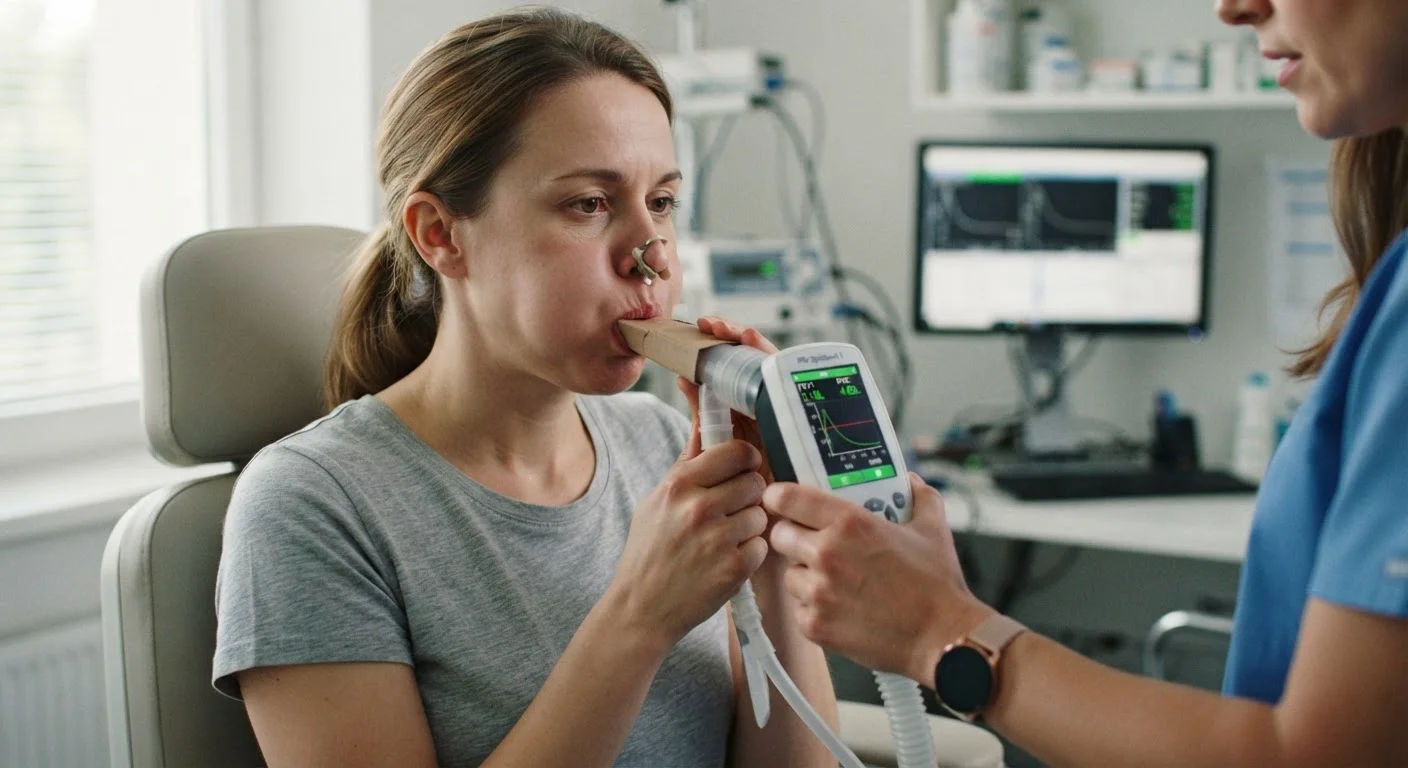
Photo: HerbHealWellness.com | Modern Guide To Wellness editorial
Key Takeaways
- Spirometry measures how much air you can move and how fast, providing objective data on lung function.
- The test is commonly used to detect or monitor asthma, COPD, and other respiratory conditions.
- Key results include FVC and FEV1; the ratio between them helps classify the type of lung impairment.
- Spirometry is non-invasive and typically takes under 30 minutes in a clinical setting.
- Results must be interpreted by a qualified clinician alongside your full medical history.
What a Spirometer Measures and Why It Matters
Breathing feels automatic, but moving air efficiently through the lungs is a complex mechanical process. When something interferes with that process — inflamed airways, stiff lung tissue, weakened respiratory muscles — it often shows up in measurable changes long before symptoms become severe. A spirometer captures these changes objectively.
The device records two foundational measurements. Forced vital capacity (FVC) is the total volume of air exhaled as forcefully and completely as possible after a maximum inhalation. Forced expiratory volume in one second (FEV1) is the volume expelled in just the first second of that effort. The ratio of FEV1 to FVC — expressed as a percentage — is one of the most diagnostically significant numbers in respiratory medicine.
A reduced FEV1/FVC ratio points toward an obstructive pattern, where airflow is impeded (as in asthma or COPD). A normal or elevated ratio with reduced overall volumes suggests a restrictive pattern, where lung expansion itself is limited (as in pulmonary fibrosis). This distinction guides the entire clinical workup that follows.
FEV1/FVC < 0.70
Threshold indicating airflow obstruction
According to Global Initiative for Chronic Obstructive Lung Disease (GOLD) criteria, a post-bronchodilator FEV1/FVC ratio below 0.70 is used to confirm the presence of persistent airflow limitation consistent with COPD.
~30 min
Typical duration of a spirometry appointment
Including patient preparation, multiple breathing maneuvers, and possible bronchodilator testing, a standard spirometry session generally takes under 30 minutes in most clinical settings.
3+ maneuvers
Minimum reproducible efforts required
American Thoracic Society and European Respiratory Society quality standards require at least three acceptable and reproducible spirometry maneuvers to ensure result reliability.
What Happens During a Spirometry Test
The test is performed in a clinic, pulmonology office, or hospital respiratory lab. A technician — often a respiratory therapist — will walk you through the procedure step by step. You will be seated upright, fitted with a nose clip to prevent air escaping through your nostrils, and asked to seal your lips around a disposable mouthpiece connected to the spirometer.
The maneuver itself involves breathing in as deeply as possible, then exhaling as hard and fast as you can until your lungs are completely empty. This is repeated at least three times to ensure reproducible results. The effort can feel strenuous, and the technician will coach you throughout. For some tests, a bronchodilator medication may be administered and the maneuver repeated afterward to assess whether the airways respond to treatment — a step called bronchodilator reversibility testing.
Getting the Most Accurate Results
If you experience unexplained shortness of breath during everyday activities, your provider may recommend spirometry as part of the initial evaluation to understand what is happening in the lungs.
Interpreting Results: What the Numbers Indicate
Spirometry results are compared against predicted values — statistical norms derived from large populations matched for age, sex, height, and ethnicity. A result below 80% of the predicted value for FVC or FEV1 is generally considered below the lower limit of normal, though reference ranges and interpretive guidelines vary by institution and updated standards.
It is important to understand that spirometry results are one piece of a broader clinical picture. A single number does not make a diagnosis. Clinicians interpret the pattern of results — obstructive, restrictive, or mixed — alongside symptoms, medical history, physical examination findings, and sometimes imaging or additional pulmonary function tests such as diffusion capacity (DLCO) or body plethysmography.
Spirometry Has Contraindications
Serial spirometry — repeating the test over time — is particularly valuable for monitoring the progression of chronic lung conditions and evaluating whether treatments are working. Stable or improving results can be reassuring; declining values may prompt a change in management.
This article is for informational purposes only and is not a substitute for professional medical advice, diagnosis, or treatment. Always consult a qualified healthcare provider with questions about your lung health or any medical condition.
Frequently Asked Questions
The content on this site is for informational purposes only and is not a substitute for professional advice. Always consult a qualified professional for guidance specific to your situation.