
Reading a Nutrition Label for Micronutrients Without Getting Lost

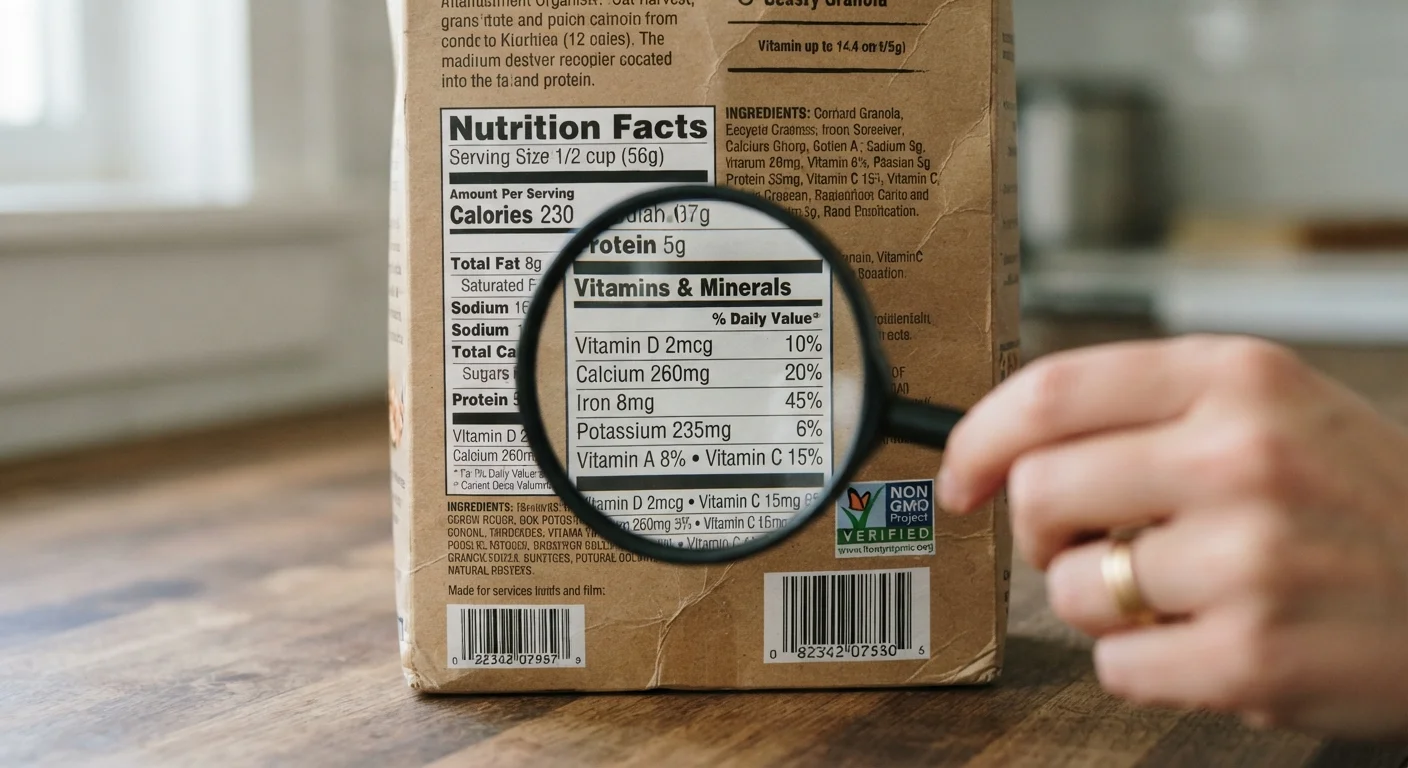
Photo: HerbHealWellness.com | Modern Guide To Wellness editorial
Key Takeaways
- Percent Daily Value (%DV) is based on a 2,000-calorie reference diet and is not a personal prescription.
- 5% DV or less is considered low; 20% DV or more is considered high for any nutrient.
- FDA rules now require Vitamin D, calcium, iron, and potassium to appear on all Nutrition Facts labels.
- Unit differences (mcg vs. mg vs. IU) matter — understanding them prevents misreading a nutrient's significance.
- Micronutrient needs vary by age, sex, and health status; always discuss specific targets with a healthcare provider.
Why the Micronutrient Section Trips People Up
Most readers scan a Nutrition Facts label for calories, fat, and sugar — and stop there. The micronutrient rows near the bottom of the panel are frequently ignored, partly because the format feels opaque. What does "15% DV" for iron actually mean? Why is one vitamin listed in milligrams and another in micrograms? These are fair questions, and the answers are more practical than they first appear.
Micronutrients — vitamins and minerals — are nutrients your body needs in relatively small amounts but cannot produce on its own in sufficient quantities. They drive hundreds of processes: nerve signaling, oxygen transport, immune defense, bone mineralization, and more. For a broader overview of what individual vitamins do inside the body, see our guide to what vitamins actually do.
Understanding the label's micronutrient data lets you make faster, more informed comparisons between foods — without needing a nutrition degree.
What you will need
Step-by-Step: Decoding Every Micronutrient Row
Work through the following steps with an actual food package in hand for the best results. The skills transfer to any packaged product carrying a standard U.S. Nutrition Facts panel.
Locate the micronutrient section at the bottom of the panel
On a standard U.S. Nutrition Facts label, micronutrients appear below the macronutrient rows, separated by a thick rule. Since the FDA's 2020 label update, four nutrients are mandatory: Vitamin D, calcium, iron, and potassium. Others — such as Vitamin C, Vitamin A, or magnesium — may appear voluntarily. Each is listed with its name, the amount per serving, and its %DV.
Understand what Percent Daily Value (%DV) means
The %DV tells you how much of a nutrient one serving contributes toward a daily reference amount. The FDA sets these reference amounts — called Daily Values — based on recommendations from the Institute of Medicine and the USDA Dietary Guidelines, calibrated to a 2,000-calorie adult diet. Use the quick benchmark: 5% DV or less = low; 20% DV or more = high. This applies whether you are assessing a beneficial nutrient like calcium or a nutrient to limit like sodium.
Decode the unit of measurement (mg, mcg, IU)
Micronutrient amounts are expressed in different units depending on potency:
- mg (milligrams) — used for calcium, iron, potassium, Vitamin C, and others. One milligram = 1/1,000 of a gram.
- mcg (micrograms) — used for Vitamin D, Vitamin B12, folate, and iodine. One microgram = 1/1,000,000 of a gram. A nutrient listed in mcg is not less important — it simply requires a smaller quantity to meet physiological needs.
- IU (International Units) — an older measure still seen on some labels and supplements for vitamins A, D, and E. The FDA has largely transitioned Nutrition Facts labels away from IU, but you may still encounter it on older stock or dietary supplements.
The unit does not indicate importance — it indicates the scale at which that nutrient operates biologically.
Account for serving size before drawing conclusions
Every micronutrient figure on the label applies to one serving as defined by the manufacturer, not necessarily the amount you consume. If a serving is 1/2 cup but you eat 1 cup, double every figure. This step matters most with iron and potassium, where overconsumption from supplements can be harmful, and with Vitamin D, where population-wide insufficiency is common. For foundational context on how macronutrients and micronutrients work together in the diet, see Macronutrients Decoded.
Use the footnote as your reference anchor
At the very bottom of most Nutrition Facts panels is a footnote stating: "The % Daily Value tells you how much a nutrient in a serving of food contributes to a daily diet. 2,000 calories a day is used for general nutrition advice." This reminder is legally required and serves a purpose: it signals that %DV is a general benchmark, not a personalized target. Your actual needs may be higher or lower based on your age, sex, activity level, and health status.
Use %DV to Build a Balanced Day
Context, Caveats, and Common Misreads
A label tells you what is in one serving of one product. It cannot tell you whether that amount is right for your body. The %DV reference is built on a single hypothetical 2,000-calorie adult diet — it does not account for pregnancy, age, chronic conditions, or medication interactions. Pregnant individuals, young children, older adults, and anyone managing a health condition should consult a registered dietitian or physician before using label data to guide supplementation or dietary changes.
Labels also only show what the manufacturer is required or chooses to disclose. Many micronutrients — magnesium, several B vitamins, zinc — may appear voluntarily but are not mandated on every product. A food's absence of a listed micronutrient does not mean it contains none; it may simply fall below the threshold requiring disclosure, or the manufacturer opted not to test.
Labels Do Not Replace Personalized Nutrition Guidance
Finally, keep label literacy in perspective: it is one tool within a broader nutritional picture. For help interpreting the broader language of eating patterns and diet frameworks, the Diet Labels Decoded glossary is a useful companion reference. And if you also read medication labels, note that their structure and intent differ significantly — reading a medication label follows a separate logic built around safety rather than nutrition.
This article is for informational and educational purposes only and does not constitute medical or dietary advice. Consult a qualified healthcare professional for guidance specific to your health needs.
The content on this site is for informational purposes only and is not a substitute for professional advice. Always consult a qualified professional for guidance specific to your situation.