
What 'Half-Life' Actually Means for Your Medication

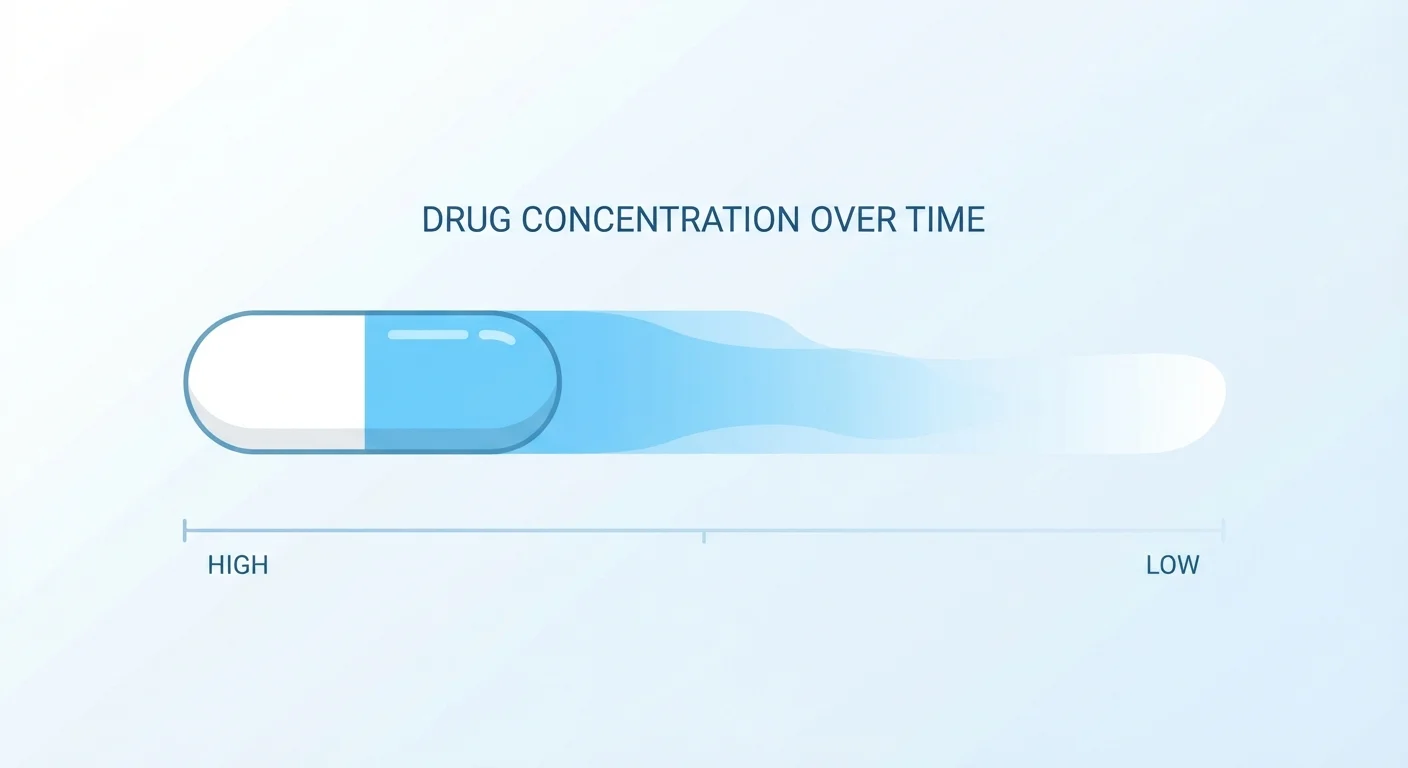
Photo: HerbHealWellness.com | Modern Guide To Wellness editorial
Key Takeaways
- Half-life tells you how long it takes for half a drug's concentration in your blood to be eliminated.
- It typically takes about five half-lives for a drug to be mostly cleared from your system.
- Longer half-life drugs can be taken less frequently; shorter half-life drugs require more doses.
- Half-life is not the same as how long a drug's effects last — these can differ significantly.
- Individual factors like age and liver health can alter how a drug's half-life behaves in your body.
Why Half-Life Matters More Than You Might Think
When your doctor prescribes a medication twice a day versus once a week, that schedule isn't arbitrary. It's largely determined by the drug's half-life — one of the most important pharmacological properties that most patients never hear explained.
Understanding the concept won't require any maths. What it will do is help you understand why skipping doses matters, why some medications linger in your body for weeks, and why your pharmacist asks about other drugs you're taking. It's also worth knowing that individual differences play a significant role — as explained in our article on why the same dose affects people differently.
Half-Life Varies Between Individuals
The Basics: What Happens After You Take a Dose
Once a drug enters your bloodstream, your body immediately begins breaking it down — primarily through the liver and kidneys. Half-life is simply the time it takes for the drug's concentration to fall to half of its peak level. Then half again. Then half again.
This process is predictable and continuous. A drug with a half-life of four hours will be at 50% of peak concentration after four hours, 25% after eight hours, 12.5% after twelve hours, and so on. By the time five half-lives have passed, less than 4% of the original concentration remains — which is why clinicians consider a drug essentially cleared after that point.
Short half-life drugs (think ibuprofen at roughly two hours) need frequent dosing to stay effective. Long half-life drugs — like some antidepressants or thyroid medications with half-lives measured in days — can be taken once daily or less, and still maintain steady levels.
~5x
Half-lives needed for full drug clearance
A widely accepted pharmacokinetic principle holds that approximately five half-lives are required to eliminate roughly 97% of a drug from the bloodstream.
20 min
Aspirin's plasma half-life
Despite this short plasma half-life, aspirin's antiplatelet effect can last seven to ten days due to its irreversible mechanism of action on platelets.
1–6 weeks
Time to steady state for some antidepressants
Long half-life antidepressants can take several weeks to reach stable therapeutic blood concentrations, which is why clinical effects are not immediate.
Steady State: Why Some Medications Take Time to Work
When you start a new medication, the drug builds up with each dose. After about four to five half-lives, the amount entering your body with each dose equals the amount being cleared — a balance called steady state. Only at steady state does the drug reach its full therapeutic effect.
This explains why antidepressants often take two to four weeks to show results, or why thyroid medications require weeks of adjustment. It's not a flaw in the drug — it's physics. Stopping abruptly or skipping doses disrupts this balance, which can cause effects to wear off unpredictably or cause withdrawal-like symptoms depending on the medication.
The same principle works in reverse: when you stop a long half-life drug, it fades from your system slowly. A short half-life drug exits quickly — which is why some medications cause more noticeable withdrawal effects than others when discontinued.
Tapering and Stopping Medications Safely
Half-Life Is Not the Whole Story
Here's an important nuance: half-life describes drug concentration in the blood, not necessarily how long its effects last. Some drugs work by binding permanently to a receptor or enzyme. Even after the drug is largely eliminated, the biological effect persists until the body regenerates the affected receptors.
Aspirin is a well-known example. It has a short half-life of about 20 minutes, but its effect on platelets (the cells involved in clotting) lasts for the entire lifespan of those platelets — about seven to ten days. That's why people taking aspirin for cardiovascular protection typically only need a daily low dose.
Understanding this distinction helps explain some terms you may see on medication inserts or labels. For a deeper look at that kind of pharmaceutical language, our plain-English glossary of drug label terms is a useful reference.
What This Means for You as a Patient
You don't need to calculate anything, but understanding half-life helps you make sense of your medication instructions and have more informed conversations with your pharmacist or provider.
- Follow dosing schedules closely. Irregular dosing with short half-life drugs causes drug levels to spike and drop erratically, reducing effectiveness and potentially increasing side effects.
- Don't stop long half-life drugs abruptly without guidance. Some need to be tapered because of how slowly they clear from the body.
- Tell your provider about all medications. Some drugs slow the liver enzymes responsible for clearing others, effectively extending their half-lives and raising blood levels in ways that can be harmful.
For a broader look at how to interpret your medication's instructions safely, see our guide on reading a medication label.
This article is for general informational and educational purposes only and is not a substitute for professional medical advice. Always consult your pharmacist or healthcare provider with questions about your medications.
Frequently Asked Questions
The content on this site is for informational purposes only and is not a substitute for professional advice. Always consult a qualified professional for guidance specific to your situation.