
Why Teeth Crack and What Determines How Serious It Is

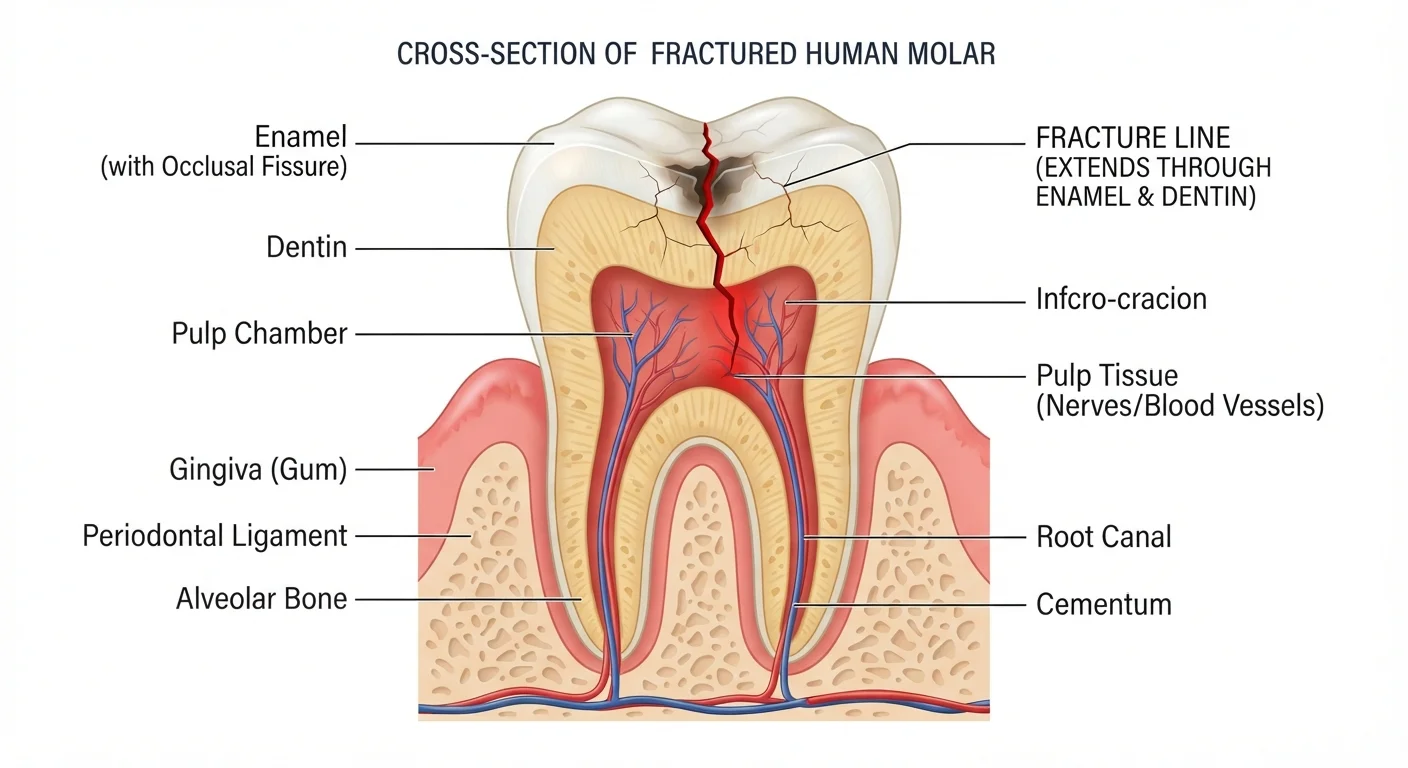
Photo: HerbHealWellness.com | Modern Guide To Wellness editorial
Key Takeaways
- Not all tooth cracks are equally serious — depth and location are the critical factors.
- Craze lines are superficial and rarely require treatment; vertical root fractures often mean tooth loss.
- Biting force, teeth grinding, and temperature extremes are among the most common causes.
- Pain that appears only when biting or releasing pressure is a classic sign of a cracked tooth.
- Early diagnosis dramatically improves outcomes — some cracks are invisible on standard X-rays.
- Always consult a dentist if you suspect a crack; self-assessment cannot determine severity.
How Teeth Crack: The Underlying Mechanics
Tooth enamel is the hardest biological material in the human body, yet it is brittle. Like glass, it can withstand sustained pressure but is vulnerable to sudden impact, repeated stress, and temperature-driven expansion and contraction. When forces exceed what the tooth structure can absorb, a fracture initiates.
Several factors set the stage for cracking. Habitual teeth grinding — a condition called bruxism — generates forces far beyond those of normal chewing, slowly fatiguing the enamel over time. Large existing restorations, particularly older amalgam fillings, can act as wedges inside the tooth, redistributing bite forces in ways that promote cracking. Repeated exposure to extreme temperature swings — alternating between very hot and very cold foods — causes microscopic expansion and contraction that gradually weakens the internal structure.
Trauma is another direct cause: a blow to the face during sports or an accident, or biting unexpectedly down on a hard object like a popcorn kernel or ice, can fracture a tooth instantly. Age is also a contributing factor; enamel becomes more brittle over decades of use.
~20%
Adults with at least one cracked or fractured tooth
Population-level dental surveys suggest cracked teeth are among the most common reasons adults seek emergency dental care in the United States.
3rd
Leading cause of tooth loss in industrialized nations
Dental fractures rank as a leading cause of tooth loss in developed countries, alongside periodontal disease and dental caries, according to dental epidemiology literature.
Up to 6x
Greater bite force from bruxism vs. normal chewing
Research in dental biomechanics indicates that nocturnal bruxism can generate forces many times greater than those produced during normal chewing, significantly increasing fracture risk.
The Spectrum of Dental Fractures
Dentists recognize distinct types of tooth fractures, and understanding them clarifies why two people who both say they have a "cracked tooth" may face very different treatment paths.
- Craze lines: Extremely shallow cracks confined to the outer enamel. They are common in adults, rarely cause symptoms, and are generally considered cosmetic. No treatment is typically required.
- Fractured cusp: A piece of the chewing surface — usually around a filling — breaks off. Because the pulp (the nerve-containing inner chamber) is usually not involved, pain is often mild and repair is straightforward.
- Cracked tooth: A fracture that extends from the chewing surface vertically toward the root. If it reaches the pulp, infection and significant pain can follow. Early intervention can often save the tooth.
- Split tooth: The result of an untreated cracked tooth progressing until the tooth divides into separate segments. Saving the entire tooth is rarely possible at this stage.
- Vertical root fracture: A fracture that begins in the root and extends upward. These are often silent — producing few symptoms until significant infection develops — and frequently lead to extraction.
For context on how progressive internal damage unfolds differently from fractures, see our article on what happens inside a cavity.
How Dentists Assess Severity
Determining how serious a crack is requires more than a visual check. Dentists use a combination of clinical tests and imaging to build a complete picture.
A bite stick test — where the patient bites down on a small instrument on each individual cusp — helps pinpoint the exact location of a crack by reproducing the characteristic pain. Transillumination, which passes a focused beam of light through the tooth, can reveal fracture lines that are invisible to the naked eye. Dye staining is another technique: a colored solution seeps into cracks and makes them visible after rinsing.
The dentist will also probe the gum around the tooth and check for the presence of a periodontal pocket along the crack line — a deep pocket indicates the fracture may extend below the gumline into the root, which worsens the prognosis significantly.
X-rays provide supporting information but have limitations. Vertical root fractures, in particular, often do not appear on standard radiographs. Cone beam computed tomography (CBCT) — a three-dimensional dental scan — offers more detail when the diagnosis is uncertain.
Keep Track of When Pain Occurs
Tooth sensitivity is frequently the first symptom that prompts a patient to seek care. Understanding that connection is worth exploring further: what tooth sensitivity is telling you.
What Influences Outcomes
Two cracks of identical depth can have different outcomes depending on their position. A crack running across the tooth — toward the root but remaining above the gumline — is generally more treatable than one that has already crossed below it. Cracks involving the pulp require root canal therapy before the tooth can be restored, while cracks confined to enamel and dentin may be addressed with a crown alone.
The extent of remaining healthy tooth structure also matters. A tooth that is already heavily restored with fillings has less natural material to hold a crown, and the prognosis worsens accordingly. Similarly, a cracked tooth that has developed an infection in the surrounding bone may no longer be restorable.
Early diagnosis is consistently the most important determinant of a positive outcome. A crack caught when it is still confined to enamel and dentin is far more manageable than one that has had time to deepen. This is one reason routine dental examinations — during which a dentist systematically examines each tooth under magnification — provide genuine value beyond cleaning.
For related structural damage that also progresses silently, the science of enamel erosion offers useful context on irreversible changes to tooth structure.
This article is for general informational purposes only and does not constitute medical or dental advice. If you are experiencing tooth pain or suspect a crack, please consult a licensed dentist for a professional evaluation.
Frequently Asked Questions
The content on this site is for informational purposes only and is not a substitute for professional advice. Always consult a qualified professional for guidance specific to your situation.