
Flossing Isn't Optional: Why It Reaches Where Your Brush Can't

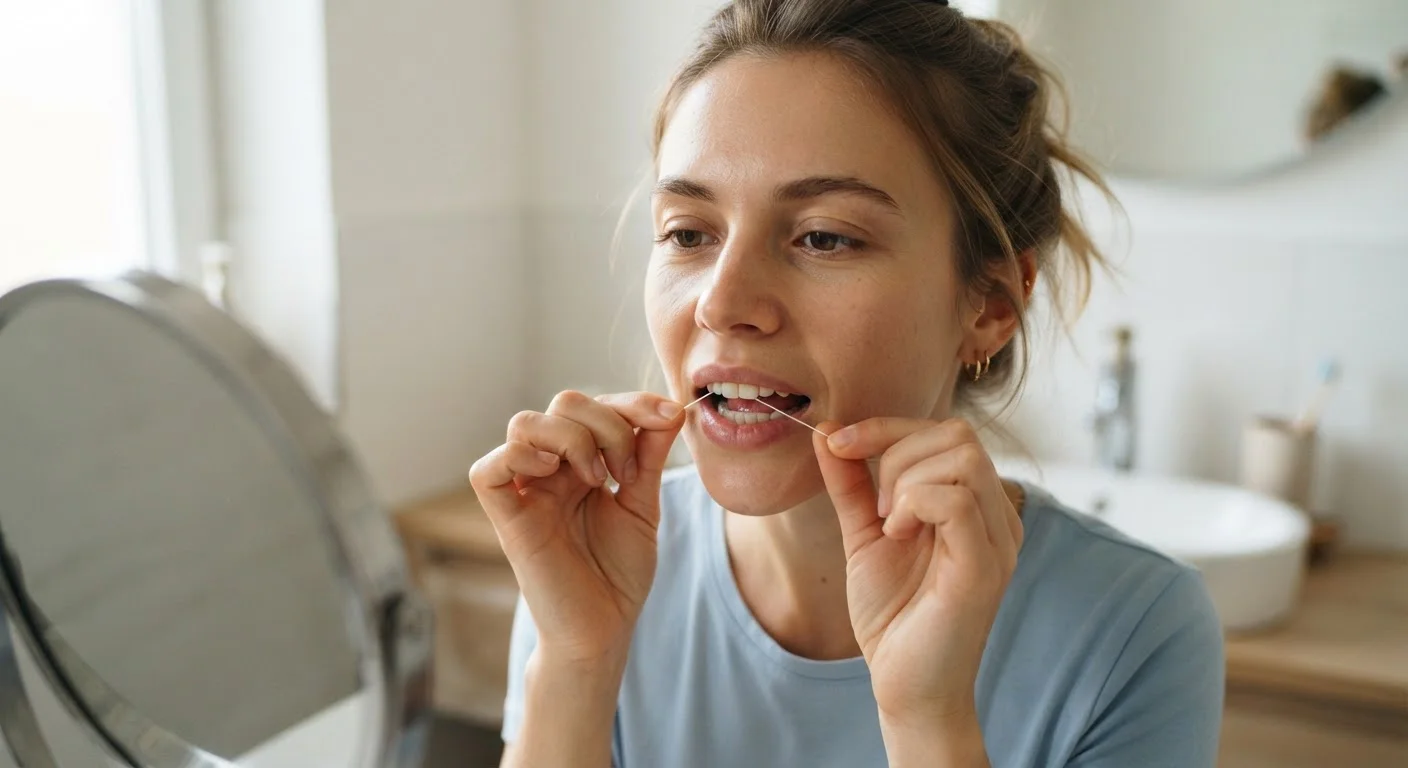
Photo: HerbHealWellness.com | Modern Guide To Wellness editorial
Key Takeaways
- Brushing alone leaves up to 40% of tooth surfaces uncleaned.
- Plaque between teeth hardens into tartar within 24–72 hours if not removed.
- Consistent flossing reduces the risk of both gum disease and interproximal cavities.
- Bleeding gums during flossing often signal inflammation, not that flossing is harmful.
- Once-daily flossing is the standard recommendation from major dental health organizations.
The Geometry Problem Your Toothbrush Can't Solve
A toothbrush — whether manual or electric — works by sweeping plaque from the front, back, and chewing surfaces of teeth. What it cannot do is navigate the tight contact points where adjacent teeth press against each other. These interproximal spaces are warm, moist, and shielded from bristle contact: ideal conditions for plaque to accumulate undisturbed.
Studies consistently show that brushing alone cleans roughly 60% of tooth surfaces. The remaining 35–40% — the sides of teeth — are left untouched unless you introduce an interdental cleaning step. Over time, the plaque left in these spaces matures, mineralizes, and hardens into calculus (tartar), which cannot be removed by brushing or flossing at home and requires professional scaling.
~40%
Tooth surface missed by brushing alone
Interproximal surfaces account for a substantial portion of total tooth area and are inaccessible to toothbrush bristles.
24–72 hrs
Time for plaque to harden into tartar
Once plaque mineralizes into calculus, it can only be removed by a dental professional, not by home hygiene alone.
~47%
U.S. adults with some form of periodontal disease
According to CDC data, nearly half of adults aged 30 and older show signs of gum disease, often linked to insufficient interdental cleaning.
Understanding this geometry helps explain why dentists aren't simply repeating advice for its own sake. Flossing addresses a structural limitation of brushing — it is not a redundant step.
What Happens When Flossing Is Skipped
Plaque is a sticky film of bacteria that forms on teeth continuously. When it sits undisturbed between teeth, the bacteria within it produce acids that erode enamel and irritate gum tissue. The consequences of chronic neglect develop along two main pathways:
- Interproximal cavities: Decay that forms on the sides of teeth, between contact points. These cavities are often invisible to the naked eye and may only be detected on X-rays during routine dental visits — by which time significant enamel loss may have already occurred.
- Periodontal disease: Persistent gum inflammation (gingivitis) that, if left unaddressed, can progress to periodontitis — a deeper infection affecting the bone and connective tissue supporting teeth. Periodontitis is a leading cause of tooth loss in adults.
Research also points to associations between chronic oral inflammation and systemic conditions including cardiovascular disease and diabetes, though the nature of these relationships is still being studied. What is established is that controlling plaque through consistent interdental cleaning is foundational to long-term oral health. For a broader view of how oral habits support whole-body outcomes, see how dental routines connect to systemic health.
Start Small If You're Building the Habit
Flossing Correctly: Technique Matters
The mechanical action of flossing — not just the act of passing floss between teeth — determines whether plaque is actually removed. A few evidence-backed technique points:
- Use enough floss. About 18 inches allows you to work with a clean section between each pair of teeth, avoiding cross-contamination of plaque.
- Curve the floss. Wrap the floss in a "C" shape around each tooth and slide it gently beneath the gumline, where plaque accumulates. Snapping the floss straight down compresses gum tissue without cleaning the pocket.
- Clean both sides. Each gap has two tooth surfaces. Curve the floss against one tooth, clean with a gentle up-and-down motion, then reposition against the adjacent tooth and repeat.
- Be consistent, not forceful. Aggressive flossing can abrade gum tissue. Gentle, methodical technique is more effective and sustainable.
For those who find standard string floss difficult due to dexterity limitations, braces, or tight contacts, there are other evidence-supported options. Our guide to interdental cleaning tools walks through how floss picks, interdental brushes, and water flossers compare. You might also consider reviewing when to floss relative to brushing for additional routine optimization guidance.
Flossing and Brushing Order
This article is for general informational purposes only and does not constitute medical or dental advice. Always consult a qualified dental professional for guidance specific to your oral health needs.
Frequently Asked Questions
The content on this site is for informational purposes only and is not a substitute for professional advice. Always consult a qualified professional for guidance specific to your situation.