
Dental Floss, Interdental Brushes, and Water Flossers: Navigating Your Options

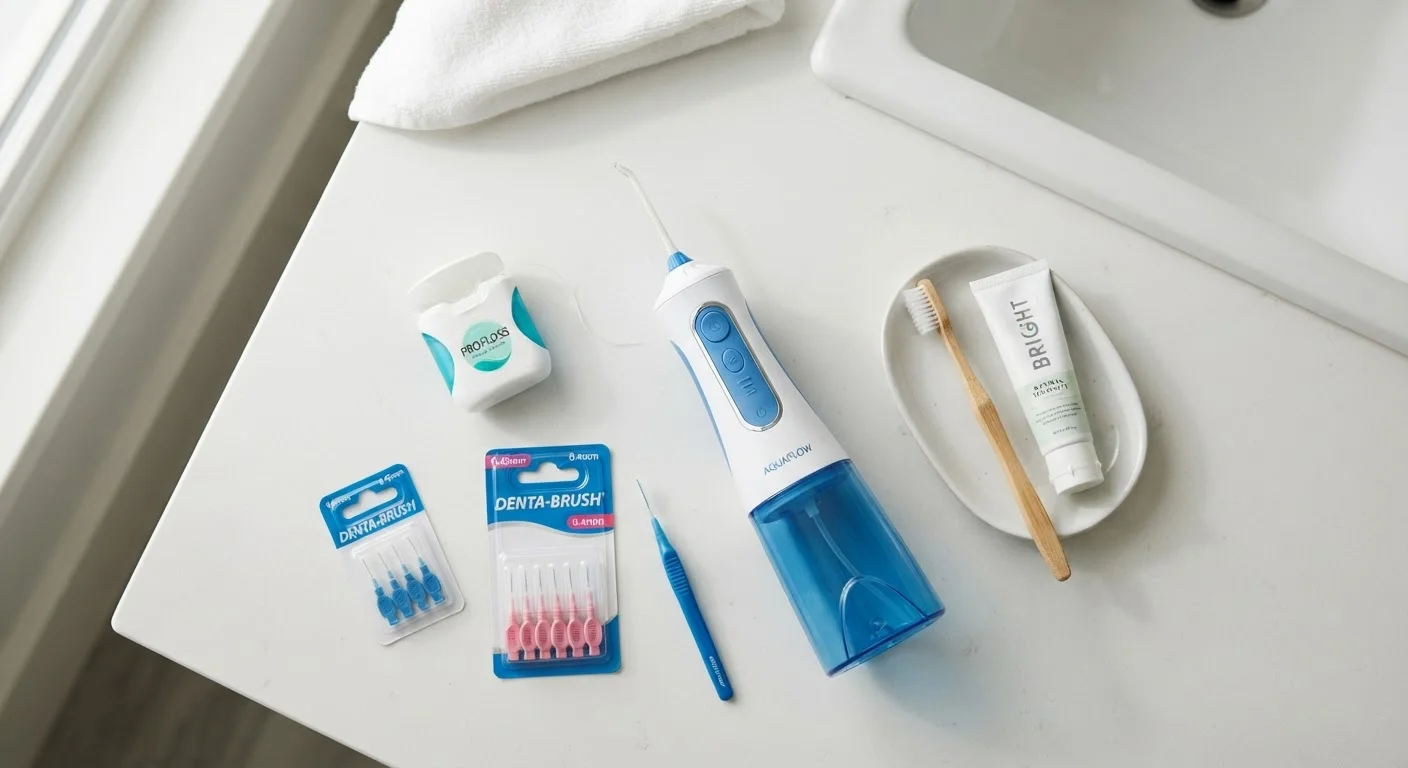
Photo: HerbHealWellness.com | Modern Guide To Wellness editorial
Key Takeaways
- Dental floss, interdental brushes, and water flossers all target the spaces between teeth that a toothbrush cannot reach.
- Interdental brushes may outperform floss for people with wider gaps or gum disease, according to clinical evidence.
- Water flossers can be useful for those with braces, implants, or limited dexterity, but should not fully replace mechanical cleaning.
- The most effective tool is the one you will use consistently — your dentist can help you choose based on your anatomy.
- No single interdental tool works best for everyone; a combination approach is sometimes recommended.
Why Interdental Cleaning Matters
Brushing, even with excellent technique, cannot reach the contact points and crevices between adjacent teeth. As detailed in our article on why flossing reaches where brushes can't, up to 40% of each tooth's surface lies in these interproximal zones. Plaque that accumulates there contributes to cavities and gum disease — two of the most common dental conditions. For a broader look at those risks, see the common dental conditions hub.
Three tools dominate this space: traditional dental floss, interdental brushes (also called interproximal or proxy brushes), and water flossers (oral irrigators). Understanding how they work — and where each falls short — helps you build a routine that actually fits your mouth.
Dental Floss: The Established Standard
Dental floss — whether waxed, unwaxed, flat, or tape — works by sliding between teeth and wrapping in a C-shape around each tooth to disrupt and remove plaque below the gumline. It is the most studied interdental tool and is endorsed by major professional bodies including the American Dental Association.
Best suited for: Adults with naturally tight tooth contacts and healthy, intact gum tissue. For children and teens, age-appropriate technique is important — see oral hygiene for children for stage-specific guidance.
Limitations: Floss requires manual dexterity and correct technique. Incorrect use — snapping floss into gums or skipping the C-curve — can cause trauma or miss significant plaque. Those with bridges, fixed retainers, or wide interdental spaces often find floss impractical.
Getting the Most From Dental Floss
Interdental Brushes: Strong Evidence, Wider Applicability
Interdental brushes are small, cylindrical or tapered brushes on a wire handle, available in multiple sizes to match varying gap widths. Multiple systematic reviews suggest they may remove more plaque than floss in individuals with moderate-to-large interdental spaces — a common feature of periodontitis (gum disease) or natural tooth spacing.
Best suited for: Adults managing gum disease, those with dental implants, crown margins, or anyone whose dentist has identified open interdental spaces. Sizing matters critically: a brush that is too small will miss contact, while one that is too large risks gum injury. A dental hygienist can measure and recommend appropriate sizes.
Limitations: Interdental brushes are not effective in very tight contacts where there is no accessible gap. They also require periodic replacement as the wire and bristles degrade.
| Dental Floss | Interdental Brushes | Water Flosser | |
|---|---|---|---|
| Plaque removal effectiveness | Strong for tight contacts | Strong, especially wider gaps | Moderate; best as adjunct |
| Ease of use | Requires technique | Easy once sized correctly | Easy, minimal technique needed |
| Suitable for braces/implants | Difficult, often impractical | Good for implants and bridges | Excellent for all appliances |
| Good for gum disease | Limited in open spaces | Well-supported by evidence | Reduces bleeding; less plaque scraping |
| Cost and convenience | Low cost, widely available | Low-to-moderate, reusable | Higher upfront cost, needs power/water |
| Dexterity requirement | High | Moderate | Low |
Water Flossers: A Useful Supplement, Not a Replacement
Water flossers deliver a pressurized stream of water to flush debris and disrupt plaque biofilm from between teeth and along the gumline. Research indicates they are effective at reducing gingival bleeding and may be superior to string floss for people with orthodontic appliances, implants, or crowns — areas where conventional tools are awkward to navigate.
Best suited for: Patients with braces, multiple restorations, or limited hand mobility. They can also help motivate people who have consistently avoided interdental cleaning.
Limitations: Water flossers do not mechanically scrape plaque biofilm as effectively as floss or interdental brushes. Most clinical guidelines position them as adjuncts rather than standalone replacements for mechanical interdental cleaning. They also require access to water, a power source, and regular maintenance.
Water Flossers Cannot Fully Replace Mechanical Cleaning
For a full picture of where interdental cleaning fits in a daily routine, our complete daily oral hygiene routine guide offers step-by-step structure from morning to night.
Choosing What Works for You
No single tool is universally superior. The most effective interdental cleaning method is the one performed correctly and consistently. Several factors should guide your choice: the size of your interdental spaces, the presence of restorations or orthodontic appliances, your manual dexterity, and any existing gum conditions.
Use the daily oral hygiene audit to identify gaps in your current routine. And when in doubt, ask your dentist or hygienist — they can assess your interdental anatomy directly and recommend specific sizes or techniques tailored to your mouth.
This article is for general informational purposes only and does not constitute medical or dental advice. Always consult a qualified dental professional for guidance specific to your oral health needs.
The content on this site is for informational purposes only and is not a substitute for professional advice. Always consult a qualified professional for guidance specific to your situation.