
Refractive Errors Explained: Why Your Vision Goes Blurry

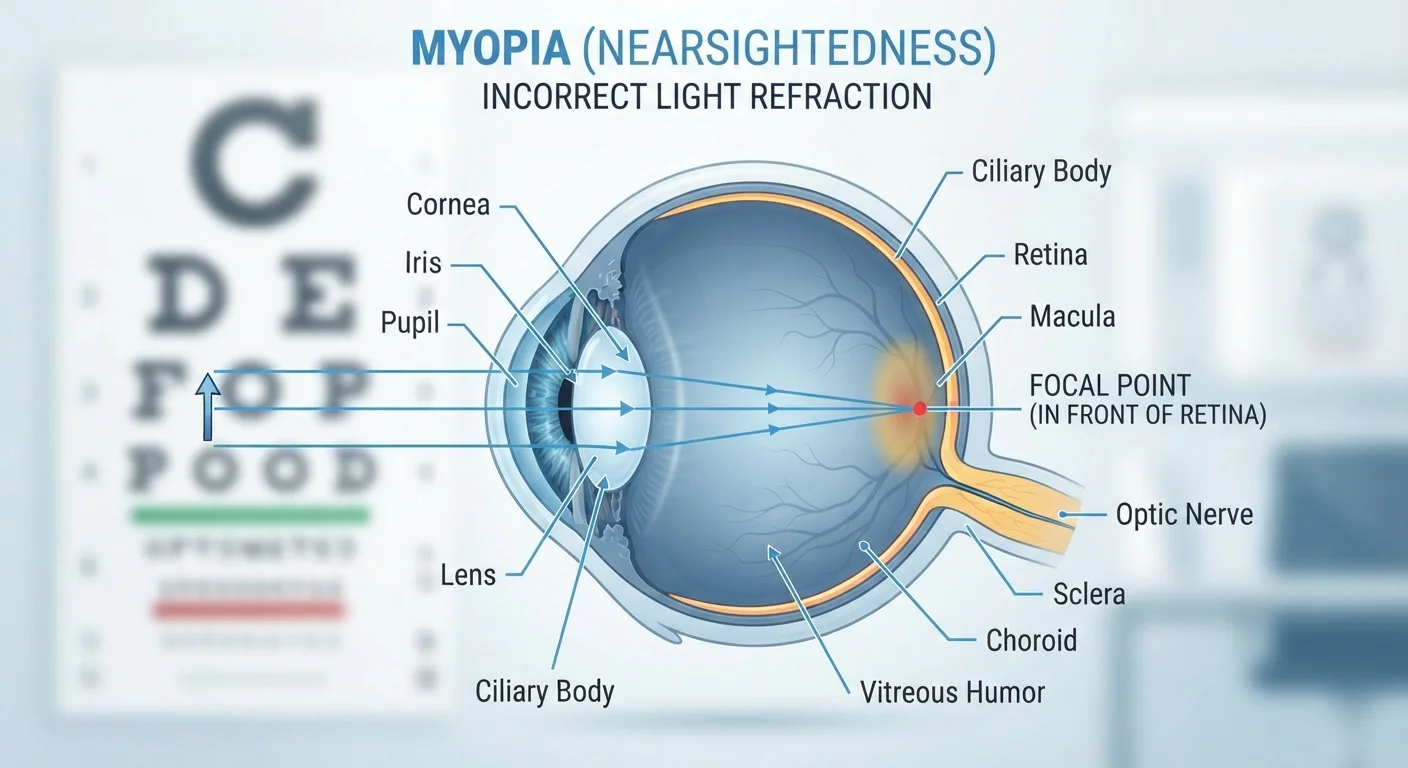
Photo: HerbHealWellness.com | Modern Guide To Wellness editorial
Key Takeaways
- Refractive errors are among the most common causes of visual impairment worldwide, yet most are easily corrected.
- The four main types are myopia (nearsightedness), hyperopia (farsightedness), astigmatism, and presbyopia.
- The shape and length of the eye — not damage to the eye itself — determine which type of refractive error a person has.
- Glasses, contact lenses, and refractive surgery are all established correction options.
- Regular eye exams are the only reliable way to detect and monitor refractive errors.
How the Eye Is Supposed to Focus Light
Vision begins when light enters the eye through the cornea — the clear dome at the front — and is further focused by the crystalline lens behind the pupil. For clear sight, this combined focusing power must direct light precisely onto the retina. The retina then converts light into nerve signals that travel to the brain via the optic nerve.
When all dimensions of the eye are in proper proportion, this system works seamlessly. A refractive error occurs when something disrupts this alignment: the eyeball may be too long or too short, or the cornea or lens may have an irregular curvature. The result is that light does not arrive at the retina as a sharp point — and the image you perceive is blurry.
Understanding the mechanics helps demystify why so many people need vision correction. Explore the full range of common eye conditions for broader context on how eye anatomy influences sight.
The Four Main Types of Refractive Error
Myopia (nearsightedness) is the most prevalent refractive error globally. The eye is longer than typical, or the cornea is steeply curved, so light focuses in front of the retina. Close objects appear clear, while distant objects look blurry. Myopia often emerges in childhood and can progress through adolescence.
Hyperopia (farsightedness) occurs when the eye is shorter than typical or the cornea is flatter, causing light to focus behind the retina. Mild hyperopia may be compensated by the eye's internal lens, especially in younger people, but this compensation can cause eye strain or headaches. Severe hyperopia makes even near objects blurry.
Astigmatism results from an eye whose cornea or lens is shaped more like a football than a sphere. This irregular curvature bends light unevenly, creating multiple focal points rather than one. People with astigmatism often experience blurring, distortion, and glare at all distances. Astigmatism frequently coexists with myopia or hyperopia.
Presbyopia is the age-related loss of near focusing ability. As the crystalline lens stiffens with age — typically from the mid-40s onward — it loses the flexibility needed to adjust focus for close tasks like reading. Unlike the other three types, presbyopia is not caused by the eye's shape but by natural changes in the lens itself. For a deeper look at this condition, see what changes after 40 with presbyopia.
2.2 billion
People worldwide with vision impairment
According to the World Health Organization, at least 1 billion of these cases involve refractive errors that have not been corrected.
~42%
U.S. adults affected by myopia
Prevalence of myopia among Americans has roughly doubled since the 1970s, according to data published in the Archives of Ophthalmology.
Over 40
Age when presbyopia commonly begins
Most adults notice difficulty reading small print or holding text at arm's length beginning in their early to mid-40s, regardless of prior refractive status.
Recognizing the Symptoms
Blurry vision is the hallmark symptom, but refractive errors can also manifest as:
- Squinting to see clearly at distance or near
- Eye strain or fatigue, especially after reading or screen use
- Frequent headaches, often around the forehead or temples
- Difficulty seeing clearly at night (particularly with myopia)
- Halos or glare around lights
- In children: sitting too close to screens, rubbing eyes, or declining school performance
Because these symptoms overlap with other eye conditions, professional evaluation is always the right first step. A standard eye exam measures how light focuses in your eye and generates a prescription if correction is needed. Visit our eye exam and prevention hub to learn how routine exams protect long-term vision.
Correction and Treatment Options
All four types of refractive error are addressable with well-established interventions:
- Eyeglasses use precisely ground lenses to compensate for the eye's focusing error. They are safe, easily updated as prescriptions change, and suitable for virtually all ages.
- Contact lenses sit directly on the cornea and offer a wider field of corrected vision than glasses. They require careful hygiene and are not appropriate for everyone.
- Refractive surgery (such as LASIK or PRK) reshapes the cornea using laser technology to permanently alter how light is focused. Eligibility depends on individual eye anatomy, prescription stability, and overall eye health.
The best option depends on lifestyle, prescription type and degree, and personal preference. For a structured comparison, see navigating your vision correction choices. Once corrected, some people still notice subtle visual discomfort — learn when corrected vision can still feel off and when to follow up with your optometrist.
Get Your Prescription Decoded
This article is for informational purposes only and does not constitute medical advice. Always consult a qualified eye care professional for diagnosis and personalized treatment guidance.
Frequently Asked Questions
The content on this site is for informational purposes only and is not a substitute for professional advice. Always consult a qualified professional for guidance specific to your situation.