
Glasses, Contact Lenses, and Surgery: Navigating Your Vision Correction Choices

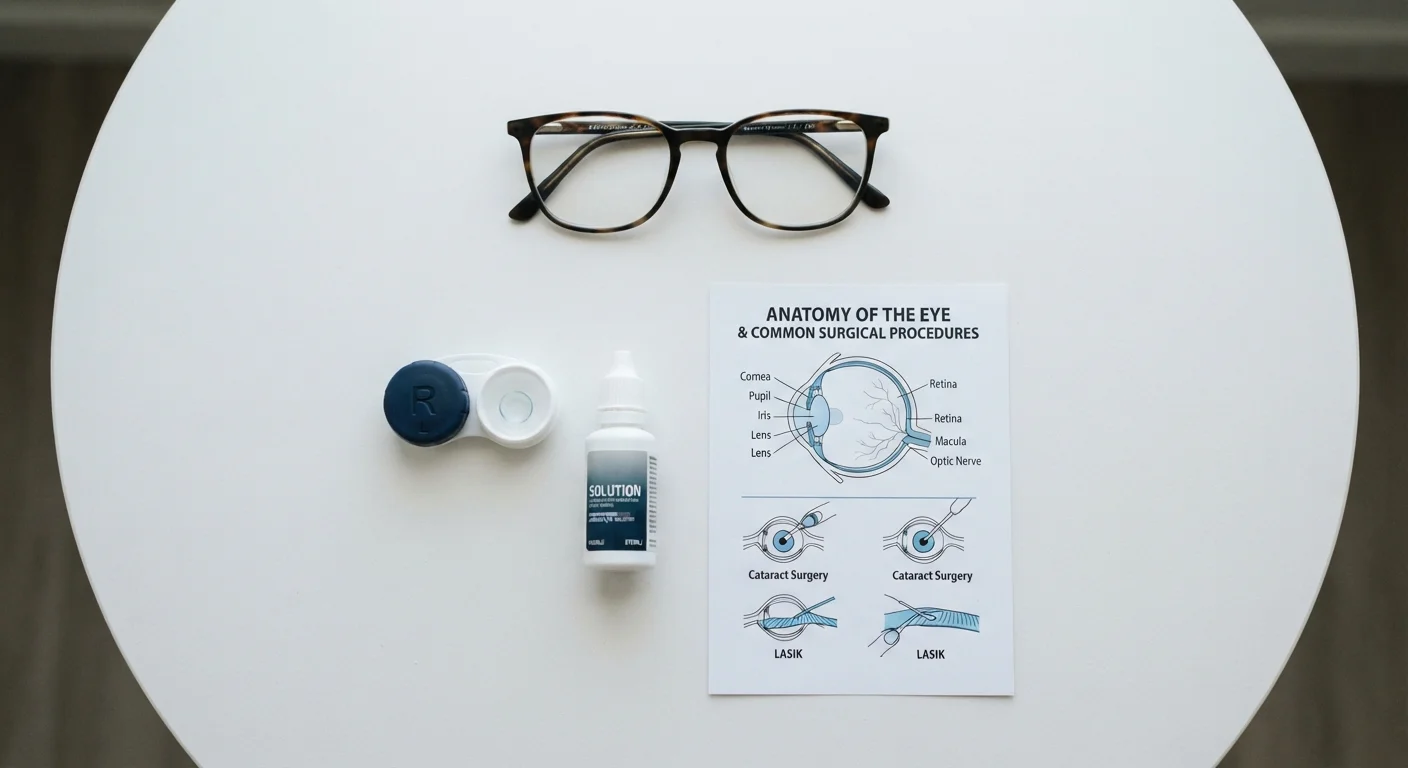
Photo: HerbHealWellness.com | Modern Guide To Wellness editorial
Key Takeaways
- Glasses, contacts, and surgery all correct refractive errors but suit different lifestyles and eye profiles.
- No single option is universally best — individual eye health, prescription, and preference all matter.
- Surgical correction is not appropriate for everyone; a thorough candidacy evaluation is essential.
- Regular eye exams remain important even after choosing a correction method.
- Always consult a qualified eye care professional before making any vision correction decision.
How Vision Correction Works
Most people who need vision correction have a refractive error — a condition in which the shape of the eye prevents light from focusing precisely on the retina. The four main types are myopia (nearsightedness), hyperopia (farsightedness), astigmatism (irregular corneal curvature), and presbyopia (age-related loss of near focus). Each of these can be addressed by glasses, contact lenses, or surgery, though the best fit depends on the type and degree of the error, overall eye health, and personal circumstances.
Understanding these basics helps frame the choices ahead. For a deeper look at common eye conditions that affect vision, including less typical diagnoses, our condition hub covers a wide range of presentations and what they mean for your care.
~2.2 billion
People globally with a vision impairment or blindness
According to the World Health Organization's World Report on Vision (2019), at least 1 billion of these cases are preventable or have not yet been addressed.
75%
US adults using some form of vision correction
The Vision Council has reported that approximately three in four American adults use eyeglasses, contact lenses, or have had corrective surgery.
~700,000
LASIK procedures performed annually in the US
Industry estimates suggest roughly 700,000 LASIK surgeries are performed in the United States each year, though figures vary by source and year.
Eyeglasses: Reliable and Versatile
Eyeglasses remain the most widely used form of vision correction worldwide. Lenses are ground to a specific prescription and work by bending incoming light before it reaches the eye, compensating for the refractive error. Modern frames accommodate a broad range of prescriptions, including high prescriptions, bifocals, and progressive lenses for presbyopia.
Glasses carry minimal risk to eye health, require no direct eye contact, and are easy to remove. They can also incorporate additional features — photochromic tinting, anti-reflective coatings, or blue-light filtering — that some wearers find useful. On the other hand, they can fog, slip, or feel cumbersome during physical activity.
Ask About Anti-Reflective Coatings
For a side-by-side comparison of glasses and contacts across practical factors, see Eyeglasses vs. Contact Lenses: Which Fits Your Lifestyle?.
Contact Lenses: Flexibility and Variety
Contact lenses sit directly on the tear film of the eye and correct vision without altering appearance or peripheral field. They come in a wide range of types — soft daily disposables, extended-wear silicone hydrogel lenses, and rigid gas-permeable (RGP) lenses — each designed for different prescription needs and wearing patterns.
Soft lenses are the most popular option for their comfort and ease of adaptation. RGP lenses, while less immediately comfortable, often provide sharper optics and are frequently used for irregular corneal shapes. Certain conditions, such as keratoconus, may require specialty lens designs that standard soft lenses cannot adequately address.
Contact lens wear does carry hygiene responsibilities. Improper cleaning, overwearing, or sleeping in lenses not approved for overnight use raises the risk of eye infections. For a structured overview of the main lens categories, Contact Lens Types at a Glance provides clear, concise guidance.
Never Sleep in Lenses Not Approved for It
Surgical Options: LASIK and Beyond
Refractive surgery aims to permanently reshape the eye — typically the cornea — so that it focuses light correctly without external aids. LASIK (laser-assisted in situ keratomileusis) is the most performed procedure; it uses a laser to reshape corneal tissue under a thin flap, offering rapid recovery for many patients. Most adults with stable prescriptions and healthy corneas are evaluated as candidates, though individual results vary and outcomes cannot be guaranteed.
LASIK is not the only surgical option. SMILE (small incision lenticule extraction), the implantable collamer lens (ICL), and refractive lens exchange (RLE) address cases where LASIK is unsuitable — for example, very high prescriptions, thin corneas, or advanced presbyopia. To understand the distinctions between these procedures, Surgical Vision Correction Beyond LASIK explores each approach in detail.
If you are considering refractive surgery, ensure your prescription has been stable for at least one to two years before your evaluation. A prescription that is still changing increases the likelihood that a surgical result will shift over time.
Request a copy of your contact lens prescription separately from your glasses prescription — they are not interchangeable. Contact lens prescriptions include fit parameters (base curve and diameter) that glasses prescriptions do not contain.
Surgical Candidacy Requires a Full Evaluation
Choosing the Right Path for You
There is no universal best option — the right choice depends on your prescription strength and stability, corneal health, lifestyle, tolerance for maintenance, and long-term goals. Younger patients whose prescriptions are still changing are generally advised to wait before considering surgery. Patients with certain corneal irregularities may find contacts more effective than surgery. Many people use more than one method at different life stages.
A comprehensive eye exam is the essential starting point for any decision. Regular exams also catch issues that can affect correction quality over time. The Eye Exam & Prevention hub outlines what to expect and why ongoing monitoring matters. If your corrected vision ever feels persistently off — blurring, strain, or headaches — understanding when to return to your optometrist can help you decide when to act. Finally, it's worth separating fact from fiction: common vision correction myths persist even among informed patients and can influence decisions in unhelpful ways.
This article is for general informational purposes only and does not constitute medical advice. Always consult a qualified eye care professional for guidance specific to your vision and eye health needs.
The content on this site is for informational purposes only and is not a substitute for professional advice. Always consult a qualified professional for guidance specific to your situation.