
Wrist vs. Upper-Arm Blood Pressure Monitors

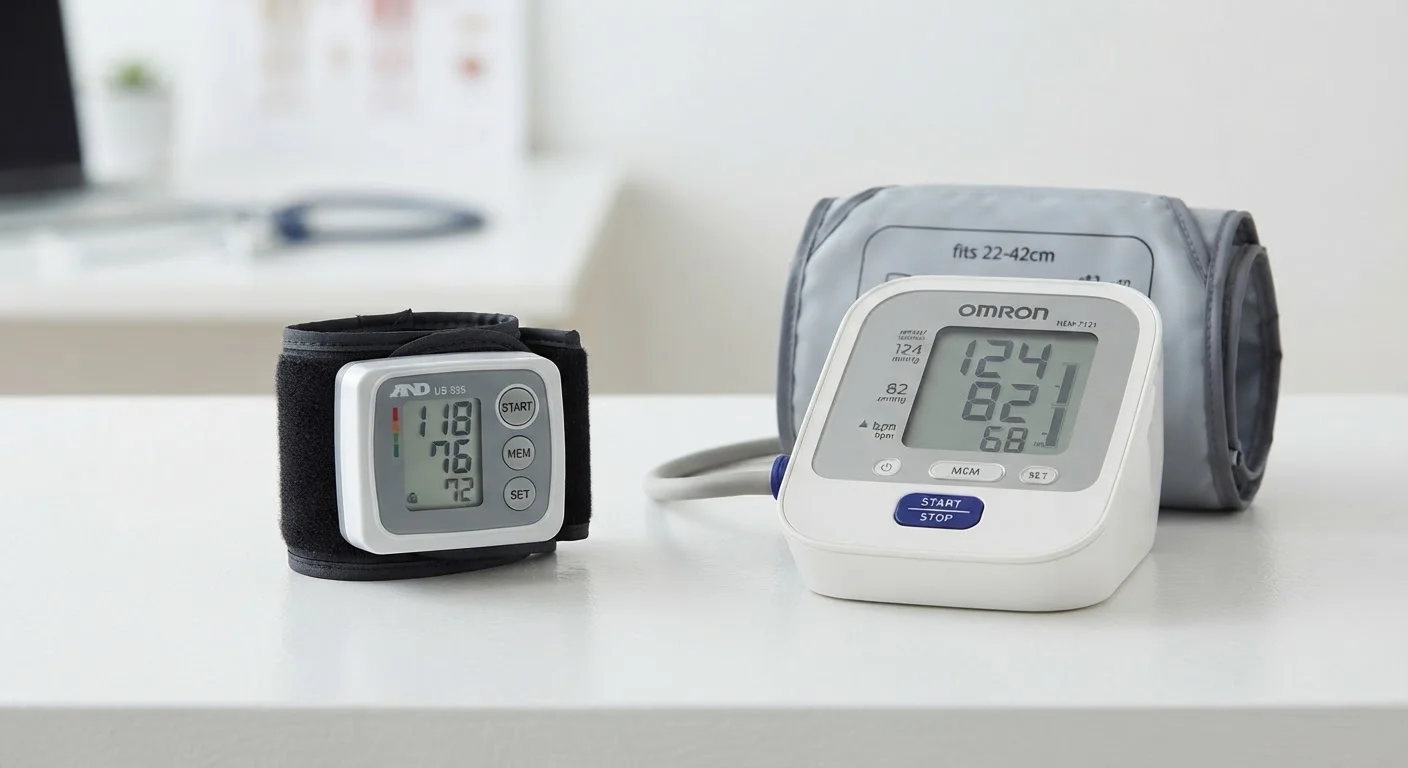
Photo: HerbHealWellness.com | Modern Guide To Wellness editorial
Key Takeaways
- Upper-arm monitors are generally recommended by major cardiovascular health organizations for home blood pressure monitoring.
- Wrist monitors are highly sensitive to arm and wrist positioning, which can introduce measurement error.
- Both device types use oscillometric technology but measure arterial pulse at anatomically different sites.
- Proper cuff fit and validated device models matter more than device type alone.
- Wrist monitors may be suitable for users whose upper arm circumference falls outside standard cuff ranges.
- Always confirm device choice with a healthcare provider, especially if monitoring for a diagnosed condition.
How Each Device Measures Blood Pressure
Both wrist and upper-arm blood pressure monitors use a method called oscillometry — the cuff inflates, temporarily compresses an artery, then deflates while sensors detect the oscillations caused by arterial pulse waves. An algorithm converts these oscillations into systolic (peak pressure) and diastolic (resting pressure) values.
The key difference is where that measurement is taken. Upper-arm monitors compress the brachial artery, the same vessel clinicians use when performing manual blood pressure assessments with a stethoscope and sphygmomanometer. Wrist monitors compress the radial and ulnar arteries, which are smaller, closer to the skin's surface, and more anatomically variable between individuals.
This anatomical distinction matters. Arterial stiffness, vessel diameter, and pulse wave characteristics all change as you move away from the heart. Measurements at the wrist can diverge meaningfully from brachial readings, particularly in older adults or people with arterial stiffness. For a deeper look at what the numbers on any blood pressure monitor actually represent, see Blood Pressure Monitors: Understanding the Numbers Behind the Reading.
| Criterion | Wrist Monitor | Upper-Arm Monitor |
|---|---|---|
| Measurement site | Radial/ulnar arteries | Brachial artery |
| Clinical preference | Generally not first-choice | Recommended by major guidelines |
| Positioning sensitivity | High — wrist must be at heart level | Moderate — arm should be supported |
| Cuff fit challenges | Varies with wrist circumference | Multiple sizes available for most arms |
| Portability | Compact and travel-friendly | Larger, less portable |
| Ease of self-application | Easier with limited arm mobility | May require assistance for some users |
| Typical validated accuracy | Variable; highly technique-dependent | More consistent across validated models |
Accuracy and Clinical Validation
Clinical and professional cardiology organizations — including the American Heart Association — generally recommend upper-arm monitors for home use, citing more consistent accuracy. Studies comparing wrist and upper-arm devices typically find that wrist monitors produce greater variability when positioning is not perfectly controlled.
Positioning is the critical variable for wrist monitors. The wrist must be held at heart level during every measurement — even a few centimeters too high or too low can produce systolic differences of 10 mmHg or more, enough to misclassify a reading as elevated or normal. Upper-arm monitors are less sensitive to small positional deviations, though correct technique still matters significantly.
~10 mmHg
Systolic error from wrist position deviation
Research has shown wrist monitor readings can shift by approximately 10 mmHg or more when the wrist is not maintained at heart level during measurement.
~70%
Adults with hypertension unaware of their status
The CDC estimates that a significant proportion of U.S. adults with high blood pressure are not adequately controlling it, underscoring the importance of accurate home monitoring.
Validation protocols — such as those used by the US Association for the Advancement of Medical Instrumentation (AAMI) or the European Society of Hypertension — test monitors against reference-standard intra-arterial measurements. Consumers should look for devices that have passed one of these recognized validation protocols. Not all monitors on the market have been independently validated. For guidance on technique that applies to both device types, see Getting Accurate Readings from a Home Blood Pressure Monitor.
Practical Considerations: Fit, Comfort, and Use Cases
Cuff fit is arguably the most consequential practical factor for either device. An upper-arm cuff that is too small will overestimate blood pressure; one that is too large may underestimate it. Most upper-arm monitors include sizing guides and are available in standard, large, and extra-large cuff sizes. For individuals whose upper-arm circumference falls outside these ranges, a properly validated wrist monitor can be a functional alternative — and is preferable to an ill-fitting upper-arm cuff.
Wrist monitors are substantially smaller and lighter, which makes them convenient for travel or for users with limited arm mobility who find upper-arm cuffs difficult to apply independently. However, that portability advantage comes with the positioning requirement described above, which some users find impractical to maintain consistently.
Special Populations: Ask Your Provider First
Blood pressure monitoring at home is one piece of a broader picture of health tracking. For context on how it fits alongside other home monitoring tools, see Home Health Monitoring Devices: A Field Guide to What They Measure.
This article is for general informational purposes only and does not constitute medical advice. Consult a qualified healthcare professional before selecting or relying on any blood pressure monitoring device, particularly if you are managing a diagnosed cardiovascular condition or monitoring during pregnancy.
The content on this site is for informational purposes only and is not a substitute for professional advice. Always consult a qualified professional for guidance specific to your situation.