
Home Health Monitoring Devices: A Field Guide to What They Measure

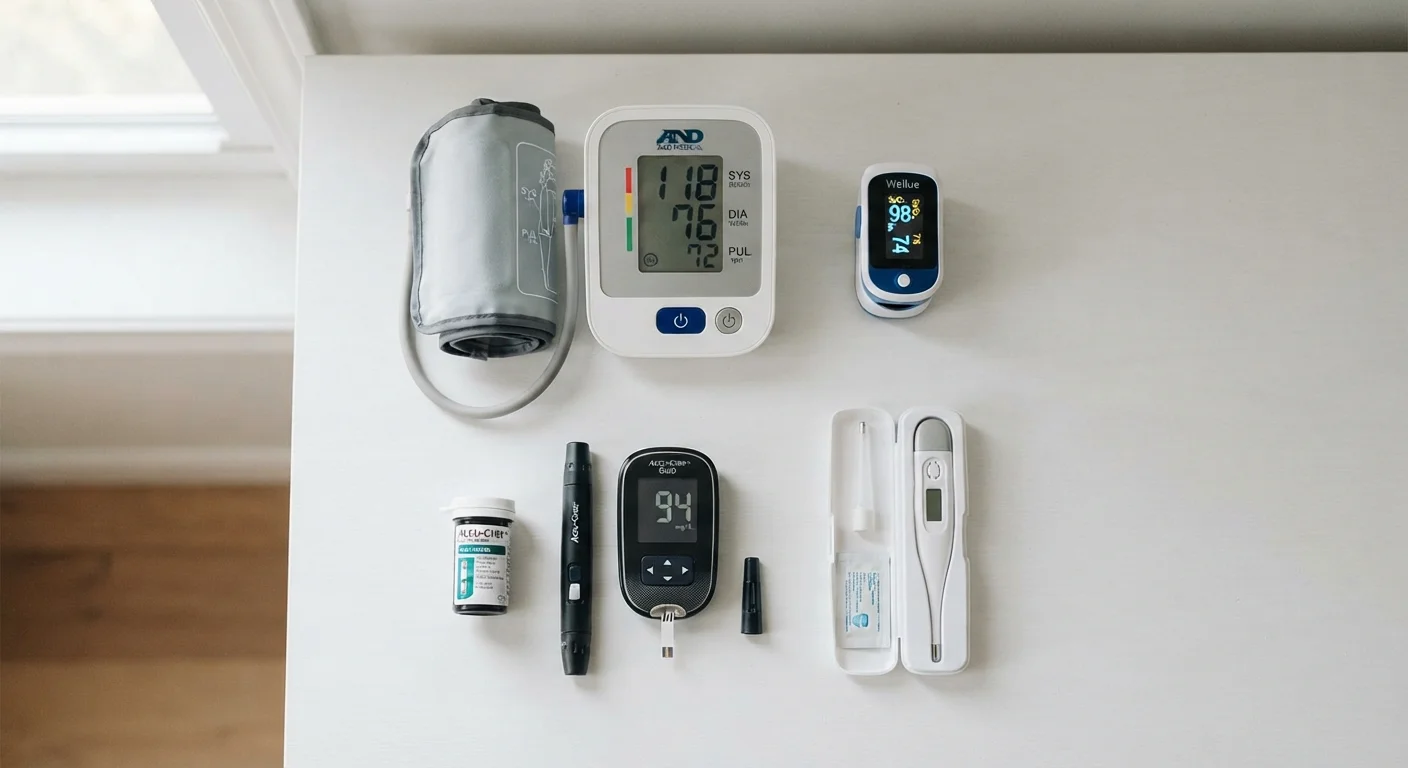
Photo: HerbHealWellness.com | Modern Guide To Wellness editorial
What Home Monitoring Devices Actually Measure
Home health monitoring devices are purpose-built tools, each designed to capture a specific physiological signal. Unlike clinical instruments calibrated for single-use diagnostic sessions, consumer-grade monitors are engineered for repeated, unsupervised use — but the underlying measurements they capture are the same vital signs clinicians rely on.
| Blood pressure units | Millimeters of mercury (mmHg) |
| Pulse oximeter measurement | Peripheral oxygen saturation (SpO₂) as a percentage |
| Blood glucose units (US standard) | Milligrams per deciliter (mg/dL) |
| Peak flow meter measurement | Peak expiratory flow in liters per minute (L/min) |
| FDA clearance for home monitors | Required before sale in the United States (U.S. Food & Drug Administration) |
| CGM sensor location | Subcutaneous (under the skin) |
Understanding what each device measures — not just what number it displays — helps you contextualize readings, recognize when a result looks unusual, and have more informed conversations with your healthcare provider. This guide covers the most widely used home monitoring categories and the science behind each metric. For guidance on fitting these devices into a consistent routine, see setting up a home health monitoring routine.
Device-by-Device Breakdown
Blood Pressure Monitors
An upper-arm or wrist cuff inflates to temporarily occlude blood flow, then slowly deflates. The device detects oscillations in arterial wall movement — a method called oscillometry — to calculate systolic pressure (peak force when the heart contracts) and diastolic pressure (baseline force between beats). Results are expressed in millimeters of mercury (mmHg). Cuff fit, body position, and recent activity all influence accuracy. See getting accurate readings from a home blood pressure monitor for step-by-step guidance.
Pulse Oximeters
A fingertip pulse oximeter shines two wavelengths of light — red and infrared — through your fingertip. Oxygenated and deoxygenated hemoglobin absorb these wavelengths differently. The device calculates the ratio to estimate peripheral oxygen saturation (SpO₂), expressed as a percentage. It simultaneously detects the pulse waveform to report heart rate. Nail polish, poor circulation, or cold extremities can reduce accuracy.
Blood Glucose Meters
A standard glucometer uses a small blood sample applied to an enzyme-coated test strip. A chemical reaction proportional to glucose concentration generates a weak electrical current, which the meter converts into a milligrams-per-deciliter (mg/dL) reading. Continuous glucose monitors (CGMs) take a different approach — a subcutaneous sensor measures glucose in interstitial fluid electrochemically in near-real time. For a deeper look at CGM technology, see the science behind continuous glucose monitoring.
Digital Thermometers
Most digital thermometers use a thermistor — a resistor whose electrical resistance changes predictably with temperature. Infrared (IR) thermometers measure thermal radiation emitted by tissue at the tympanic membrane or forehead without contact. Both methods report body temperature in degrees Fahrenheit (°F) or Celsius (°C). Site selection — oral, axillary, tympanic, or temporal — affects the reading and has different normal reference ranges.
Peak Flow Meters
A peak flow meter measures the maximum speed of exhalation in liters per minute (L/min), called peak expiratory flow (PEF). This reflects how open the larger airways are and is commonly used by people managing asthma to detect airway narrowing before symptoms become severe. Results are interpreted relative to a personal best baseline, not a universal threshold.
Systolic pressure
The higher of the two blood pressure numbers, representing the force exerted on artery walls when the heart contracts and pumps blood. Measured in millimeters of mercury (mmHg).
SpO₂
Peripheral oxygen saturation — an estimate of the percentage of hemoglobin molecules in arterial blood that are carrying oxygen. Measured non-invasively by a pulse oximeter.
Peak expiratory flow (PEF)
The maximum speed at which a person can exhale air, measured in liters per minute. Used to assess large airway obstruction, particularly in asthma management.
Oscillometry
The method used by most automated blood pressure monitors to detect blood pressure by sensing vibrations in the arterial wall as cuff pressure is released.
Interstitial fluid
The fluid surrounding cells in body tissue, distinct from blood. Continuous glucose monitors measure glucose in this fluid as a proxy for blood glucose levels.
Thermistor
An electronic component whose electrical resistance changes in a predictable, measurable way with temperature. Used in most digital contact thermometers to produce temperature readings.
Interpreting Readings and Knowing Their Limits
Every home monitoring device produces data with a margin of error. Consumer-grade devices cleared by the FDA meet defined accuracy standards, but individual readings can still vary due to technique, device calibration, and physiological factors. A single abnormal reading rarely constitutes a diagnosis.
Consumer Devices vs. Clinical-Grade Instruments
Trends over time — tracked in a consistent log — are generally more informative than isolated readings. If your device connects to a smartphone app, review the trend data and bring it to appointments rather than relying on a single figure. For a broader view of how monitoring needs shift across life stages, see health monitoring devices across the lifespan.
Home monitors complement, but do not replace, clinical assessment. If a reading consistently falls outside your provider's recommended range, or if you experience symptoms alongside an abnormal reading, contact a healthcare professional promptly. For more on where home tracking ends and clinical screening begins, see self-monitoring vs. clinical screening.
This article is for general informational purposes only and is not a substitute for professional medical advice, diagnosis, or treatment. Always consult a qualified healthcare provider with questions about your health or any medical device readings.
The content on this site is for informational purposes only and is not a substitute for professional advice. Always consult a qualified professional for guidance specific to your situation.