
Inside the Pill: What Happens After You Swallow a Medication

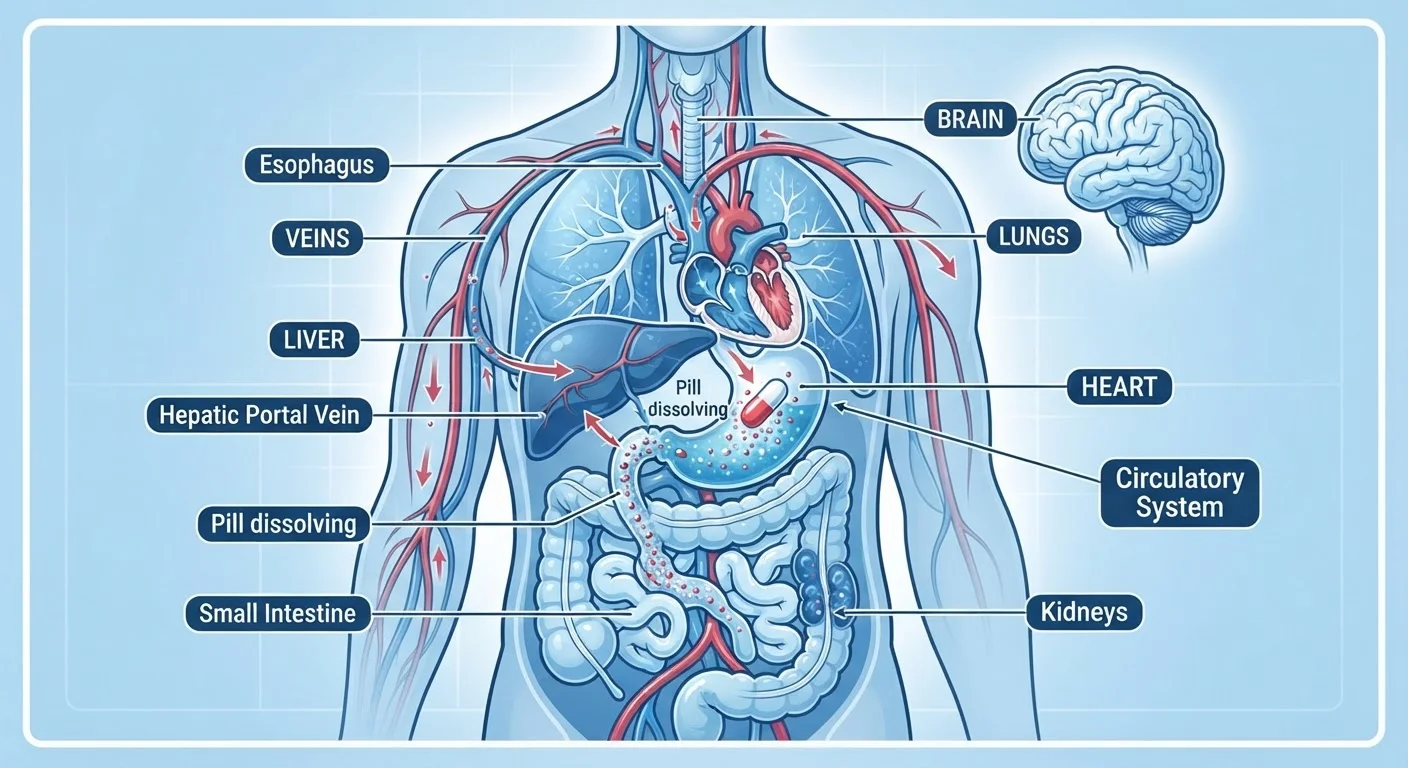
Photo: HerbHealWellness.com | Modern Guide To Wellness editorial
Key Takeaways
- A swallowed pill must dissolve in the stomach before it can be absorbed into the bloodstream.
- The liver plays a major role in breaking down drugs before they reach the rest of the body.
- Different drugs are designed to release their active ingredient at different speeds and locations.
- Body factors like age, weight, and kidney function affect how medications are processed.
- Understanding this journey explains why dosing schedules and timing instructions exist.
Step One: Dissolving in the Stomach
The journey begins the moment you swallow. A solid tablet or capsule isn't immediately useful to the body — the active ingredient must first be released and dissolved into liquid form before it can be absorbed. This dissolution process happens primarily in the stomach, where gastric acid and mechanical churning break down the pill's outer layers.
Not all pills dissolve the same way. Some are immediate-release formulations designed to break down quickly, producing effects within 30 to 60 minutes. Others carry special enteric coatings — protective shells that resist stomach acid and only dissolve once the pill reaches the small intestine. This design is used either to protect your stomach lining from irritating drugs or to protect the drug itself from being destroyed by stomach acid.
Extended-release tablets use a matrix or layered structure to slowly release the active ingredient over hours. That's why crushing or splitting these pills can be dangerous — it removes the controlled-release mechanism and delivers too much drug at once. Reading your medication label carefully will often indicate whether a tablet should never be split or crushed.
Step Two: Entering the Bloodstream
Once dissolved, the drug's active molecules cross the wall of the small intestine — a surface lined with millions of tiny finger-like projections called villi — and pass into the surrounding blood vessels. This is the absorption step, and it's where most of a drug's journey begins in earnest.
From the intestinal blood vessels, the drug is carried directly to the liver via the portal vein. This is where something important happens: the liver immediately begins processing the incoming drug in what's called first-pass metabolism. Liver enzymes chemically alter many drugs, sometimes converting them into different compounds (called metabolites) and reducing how much active drug makes it into the general bloodstream. For some medications, this effect is so significant that oral doses must be much higher than intravenous doses to achieve the same result.
~40–60%
Bioavailability of many common oral drugs
First-pass liver metabolism means a significant portion of some orally taken drugs never reaches general circulation, according to general pharmacology literature.
30–60 min
Typical onset time for oral immediate-release tablets
Most standard oral medications begin producing measurable blood concentrations within this window, though individual variation is common.
Over 50%
Adults taking at least one prescription drug
According to CDC data, more than half of US adults use at least one prescription medication, making drug literacy a broadly relevant public health concern.
The fraction of a drug that successfully reaches systemic circulation after this process is referred to as its bioavailability. A drug with 50% bioavailability means only half of the dose you took is working throughout your body.
Step Three: Distribution and Reaching the Target
Once in the bloodstream, the drug travels throughout the body. But reaching the right place isn't automatic. Several factors determine where a drug ends up — including how well it dissolves in fat versus water, how tightly it binds to proteins in the blood, and whether specific barriers (like the blood-brain barrier) limit access to certain tissues.
Drugs bind to specific receptors — protein structures on or inside cells — like a key fitting a lock. When the right drug molecule docks with the right receptor, it triggers or blocks a biological process. A pain reliever, for example, may bind to receptors involved in inflammation signaling, reducing the pain message sent to your brain. An antibiotic may target structures unique to bacterial cells, leaving human cells unharmed.
Take Medications as Directed for a Reason
This targeting precision is also why drug interactions can be problematic. When two drugs compete for the same receptors or metabolic pathways, their effects can amplify or cancel each other out. Understanding this helps explain the guidance covered in detail in our article on how mixing medications can change everything.
Step Four: Metabolism and Elimination
After a drug has done its work, the body needs to remove it. The liver continues to metabolize (chemically transform) the drug into forms that are easier to excrete, and the kidneys filter these byproducts out of the blood and into urine. Some drugs are also eliminated through bile, feces, sweat, or exhaled air.
The speed of elimination is measured by a drug's half-life — the time it takes for the concentration in the blood to drop by half. A drug with a short half-life clears quickly and may need to be taken multiple times daily. A drug with a long half-life stays active much longer and might only require once-daily or even weekly dosing.
Individual factors heavily influence this entire four-stage process. Age, liver and kidney health, genetics, body composition, and even other medications all affect how efficiently drugs are absorbed, distributed, metabolized, and excreted. This is why medication doses aren't one-size-fits-all — and why it's important to share your full medical history and current medication list with your healthcare provider and pharmacist. For a deeper look at these four stages as a complete system, see our overview of pharmacokinetics explained for beginners.
This article is for informational purposes only and is not a substitute for professional medical advice. Always consult a licensed healthcare provider or pharmacist about your specific medications and health situation.
Frequently Asked Questions
The content on this site is for informational purposes only and is not a substitute for professional advice. Always consult a qualified professional for guidance specific to your situation.