
Pharmacokinetics: A Beginner's Map of How the Body Handles Drugs

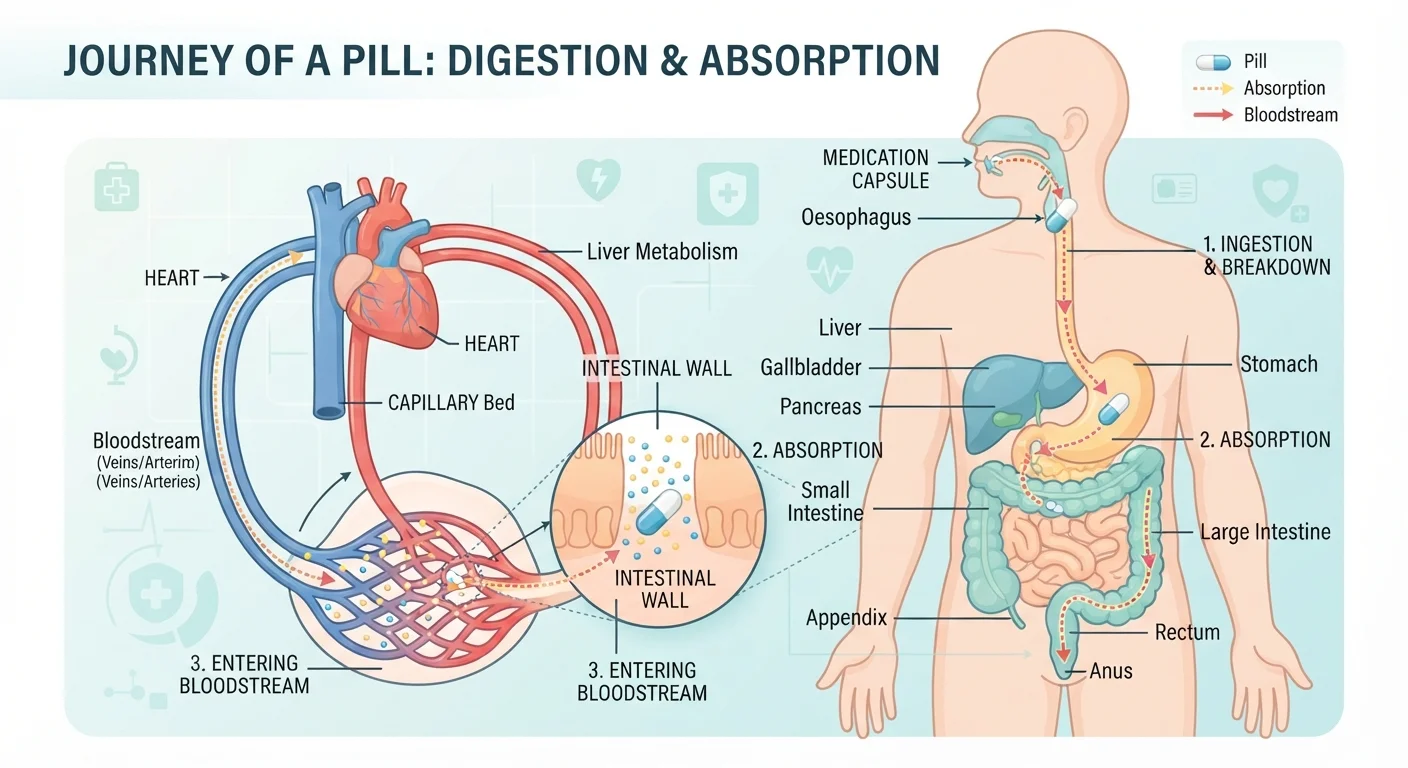
Photo: HerbHealWellness.com | Modern Guide To Wellness editorial
Key Takeaways
- Pharmacokinetics describes what the body does to a drug — absorption, distribution, metabolism, and excretion.
- Absorption depends on the drug's form, route of administration, and individual digestive factors.
- The liver is the body's primary drug-processing organ; its function directly affects how long a drug stays active.
- Most drugs exit the body through the kidneys in urine, making kidney health relevant to drug safety.
- Individual factors like age, genetics, and other medications can alter all four stages significantly.
- Understanding ADME helps you follow dosing instructions more confidently and recognize why timing matters.
What Is Pharmacokinetics?
When you swallow a tablet, your body immediately gets to work. It has to absorb the drug, move it where it's needed, break it down, and eventually remove it. The science that describes all of this is called pharmacokinetics — literally, "the movement of drugs."
Pharmacokinetics is often summarized by the acronym ADME: Absorption, Distribution, Metabolism, and Excretion. These four stages happen in sequence, and together they determine how quickly a drug takes effect, how long it stays active, and how it ultimately leaves the body.
Understanding ADME isn't just for scientists. It's the framework that explains why you take some medications with food, why others require twice-daily dosing, and why a dose that works well for one person might need adjustment for another. For a complementary look at the molecular side of this process, see what happens after you swallow a medication.
Pharmacokinetics
The study of how the body absorbs, distributes, metabolizes, and excretes a drug over time.
ADME
An acronym for the four stages of pharmacokinetics: Absorption, Distribution, Metabolism, and Excretion.
First-pass effect
The partial breakdown of an oral drug by the gut wall and liver before it reaches the bloodstream, reducing the amount of active drug available.
Bioavailability
The fraction of a drug dose that reaches the bloodstream in an active form and is available to produce an effect.
Half-life
The time it takes for the concentration of a drug in the blood to decrease by half, used to determine appropriate dosing intervals.
CYP450 enzymes
A family of liver enzymes responsible for breaking down most drugs; differences in these enzymes between individuals can affect how quickly a drug is metabolized.
Protein binding
The attachment of drug molecules to blood proteins like albumin; only the unbound portion of a drug is active and able to exert its effect.
Metabolite
A substance produced when the body chemically transforms a drug; some metabolites are active and continue to have effects, while others are inactive.
Stage 1: Absorption
Absorption is the process by which a drug moves from its point of entry into the bloodstream. For an oral pill, that entry point is your gastrointestinal (GI) tract — primarily the small intestine, where most absorption takes place.
Several factors influence how well a drug is absorbed:
- Drug formulation: Immediate-release tablets dissolve quickly; extended-release forms are designed to release the drug gradually over hours.
- Route of administration: Drugs given intravenously (IV) skip absorption entirely — they go directly into the blood. Drugs applied to the skin, inhaled, or placed under the tongue each follow different absorption pathways.
- Food and stomach contents: Some drugs absorb better on an empty stomach; others require food to reduce irritation or improve uptake.
- Individual GI factors: Conditions like Crohn's disease or gastric bypass surgery can alter how much of a drug is absorbed.
Not all of an absorbed drug reaches circulation intact. Some is broken down in the gut wall or liver before it even enters the bloodstream — a process called the first-pass effect. This is why oral doses are sometimes much higher than IV doses of the same drug.
Always Read the "Take With Food" Instructions
Stage 2: Distribution
Once a drug reaches the bloodstream, it travels throughout the body — but not uniformly. Distribution describes how a drug spreads from the blood into tissues and organs.
Key factors shaping distribution include:
- Blood-brain barrier: The brain is protected by a selective barrier. Only certain drugs can cross it, which is why brain conditions can be challenging to treat.
- Protein binding: Many drugs hitch a ride on proteins in the blood, particularly albumin. Only the "unbound" portion of a drug is pharmacologically active — meaning it can actually interact with target receptors.
- Body composition: Fat-soluble drugs tend to accumulate in fatty tissue; water-soluble drugs stay closer to body fluids. A person's body composition can affect how widely a drug spreads.
Distribution also explains why some drugs have a delayed onset — they need time to reach the specific tissue where they act.
Stage 3: Metabolism
Metabolism is the body's process of chemically transforming a drug, usually into a form that is easier to excrete. The liver is the primary site of drug metabolism, though the gut, lungs, and kidneys also play supporting roles.
The liver uses a family of enzymes — most notably the CYP450 enzymes (cytochrome P450) — to break down drugs. Metabolism can:
- Inactivate a drug, reducing or ending its effect
- Convert a drug into an active metabolite that continues to work
- Transform a harmless drug into a harmful byproduct in rare cases
Metabolism is also the stage most affected by drug interactions. When two drugs compete for the same enzyme, one can slow the breakdown of the other — causing it to build up to higher-than-intended levels. This is a key reason why mixing medications can change everything.
Liver disease, age-related changes, and certain genetic variations can all alter metabolic rates. For more on how individual biology shapes drug response, see why the same dose affects people differently.
Never Adjust Doses Based on How You Feel
Stage 4: Excretion
Excretion is the final stage — the body eliminating the drug and its metabolites. The kidneys are the primary excretion organ, filtering drug byproducts out of the blood and into the urine. Some drugs and their byproducts are also excreted in bile, feces, sweat, or exhaled air.
A critical concept here is half-life — the time required for the concentration of a drug in the blood to fall by 50%. A drug with a short half-life clears quickly and may require multiple daily doses. A drug with a long half-life lingers in the body and may only need to be taken once a day or even less frequently.
Kidney function matters greatly at this stage. Impaired kidneys may not clear drugs efficiently, allowing them to accumulate and increase the risk of toxicity. This is why people with chronic kidney disease often require dose adjustments. For a plain-language breakdown of terms like half-life and bioavailability, the drug label glossary is a useful companion reference.
Why This Matters for Your Health
Pharmacokinetics isn't just an academic concept — it has real implications for how you take medications safely and effectively. Here's how ADME translates into everyday decisions:
- Timing and food instructions on your prescription label exist because they directly affect absorption. Following them improves how well a drug works.
- Dose intervals are set based on half-life to maintain a steady therapeutic level in the blood — not too much, not too little.
- Reporting all medications to your prescriber and pharmacist — including supplements and over-the-counter drugs — helps identify potential metabolic conflicts before they become problems.
- Kidney and liver conditions should always be disclosed, as they affect clearance and can require dose modifications.
If you're new to managing prescriptions, the first-time prescription walkthrough is a practical starting point. And for a broader look at drug safety, explore the Drug Safety & Interactions hub.
Pharmacokinetics Varies From Person to Person
This article is for informational purposes only and is not a substitute for professional medical advice. Always consult your pharmacist or healthcare provider before making decisions about your medications.
Frequently Asked Questions
The content on this site is for informational purposes only and is not a substitute for professional advice. Always consult a qualified professional for guidance specific to your situation.