
The Science Behind Portion Sizes — and Why We Misjudge Them

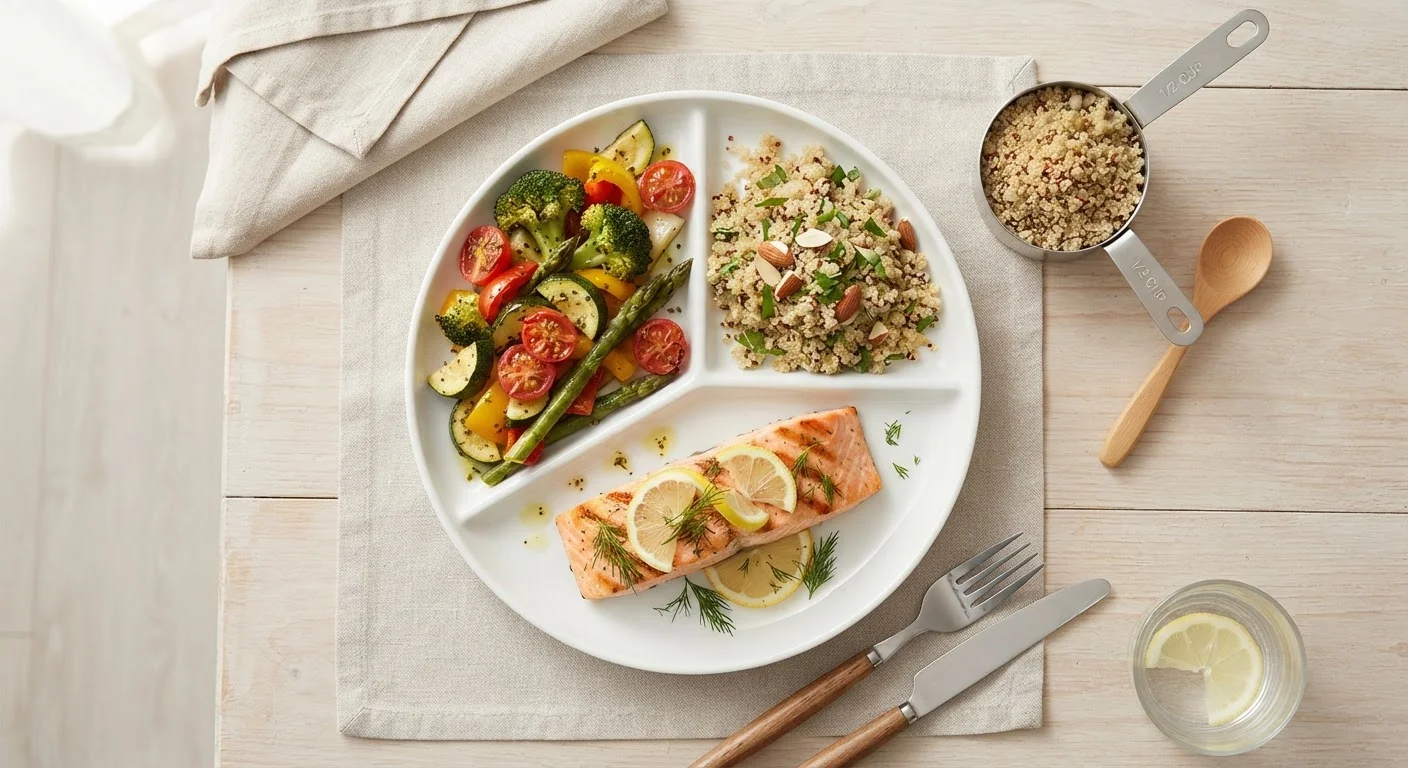
Photo: HerbHealWellness.com | Modern Guide To Wellness editorial
Key Takeaways
- Portion sizes and serving sizes are not the same — knowing the difference matters for accurate food tracking.
- Visual and environmental cues consistently cause people to underestimate how much they eat.
- Plate size, packaging, and social context are documented drivers of unintentional overconsumption.
- Hand-based reference anchors offer a practical way to estimate portions without weighing food.
- Awareness of portion distortion is a more sustainable skill than calorie counting alone.
Why Your Eyes Are Unreliable Portion Guides
Most people believe their hunger and visual judgment keep their eating in check. The evidence suggests otherwise. A landmark series of studies by Cornell food researcher Brian Wansink — and subsequently replicated in various forms by other labs — demonstrated that environmental cues, not internal appetite signals, drive the majority of eating decisions. Plate size, bowl depth, package volume, and even lighting all shape how much food a person perceives as appropriate.
One well-documented phenomenon is the Delboeuf illusion: the same circle appears larger when surrounded by a smaller ring and smaller when surrounded by a larger one. Applied to food, the same portion of pasta looks abundant on a side plate and sparse on a dinner platter. The brain responds to that perceived abundance or scarcity — and dish-up behavior follows suit.
This isn't a failure of willpower. It reflects how human perception is built: context-dependent, relative, and heavily influenced by learned norms. Understanding that the visual system is systematically unreliable is the first step toward correcting for it.
Serving Size Is Not a Recommendation
The Portion Distortion Problem
Over the past four decades, standard food portions in the US have grown substantially. The National Heart, Lung, and Blood Institute has documented that common foods — bagels, soda servings, pasta dishes — are now served in amounts two to five times larger than they were in the 1980s. As these larger portions became the norm, public perception of what constitutes a 'regular' amount shifted in lockstep.
This matters because perceived norms anchor behavior. If a restaurant entrée routinely contains 1,200 calories and that feels normal, a 600-calorie meal can feel like deprivation — even though it may align more closely with appropriate intake for that meal. Understanding this drift helps readers interpret their own habits without self-blame, while still identifying where calibration is useful.
2–5x
Growth in common US food portions since the 1980s
The National Heart, Lung, and Blood Institute documented this increase across staple foods including bagels, soda, and restaurant pasta dishes.
15–20 min
Time for satiety hormones to signal fullness
Physiological research indicates that hormonal fullness signals take this long to reach the brain after eating begins, making eating speed a key intake variable.
~30%
More food served onto larger plates on average
Multiple controlled studies in nutrition behavior research found that participants consistently served larger amounts when given bigger plates or bowls.
For a deeper look at how food labeling connects to this issue, see how to read a nutrition label — particularly the serving size row, which is the first place most people go wrong.
Practical Anchors for Estimating Portions
Weighing every meal is accurate but impractical for most people. A more sustainable approach uses hand-based reference anchors, which are proportional to body size and require no equipment:
- Palm: Approximately one serving of protein (chicken, fish, legumes) — about 3–4 oz for most adults.
- Cupped hand: One serving of grains, cereal, or cooked pasta.
- Fist: One serving of raw vegetables or fruit.
- Thumb: One serving of fats such as nut butter or oil (roughly 1 tablespoon).
These anchors won't replace a food scale for clinical precision, but research supports their utility for general dietary awareness. They're also built-in — always available, always scaled to the individual using them.
See what a balanced plate looks like for a visual framework that builds on these anchors across all food groups.
Use Smaller Plates at Home
Environment, Speed, and the Hidden Drivers of Intake
Beyond plate geometry, several behavioral factors reliably increase consumption without the eater noticing:
- Eating speed: The satiety hormones leptin and GLP-1 take roughly 15–20 minutes to signal fullness to the brain. Eating faster means consuming more before that signal arrives.
- Variety and food palatability: Offering multiple food types at a meal — known as sensory-specific satiety — delays the point at which a person feels full from any one food, often extending total intake.
- Distracted eating: Eating while watching screens or working is associated with reduced meal recall, which leads to less accurate hunger calibration afterward and often additional snacking.
- Social influence: People tend to match the eating pace and volume of dining companions, a well-documented phenomenon in social eating research.
These aren't obscure edge cases — they operate in ordinary daily eating. Recognizing them doesn't require behavioral overhaul; even small adjustments, like eating at a table without screens, can recalibrate the experience meaningfully.
Eating the right amounts is closely linked to getting full nutritional value from food. Nutrient absorption is another layer of the equation — how much the body actually uses depends on more than what's on the plate.
This article is for general informational and educational purposes only and does not constitute medical or dietary advice. Consult a registered dietitian or qualified healthcare professional for personalized guidance.
Frequently Asked Questions
The content on this site is for informational purposes only and is not a substitute for professional advice. Always consult a qualified professional for guidance specific to your situation.