
Vision Screening vs. Comprehensive Eye Exam

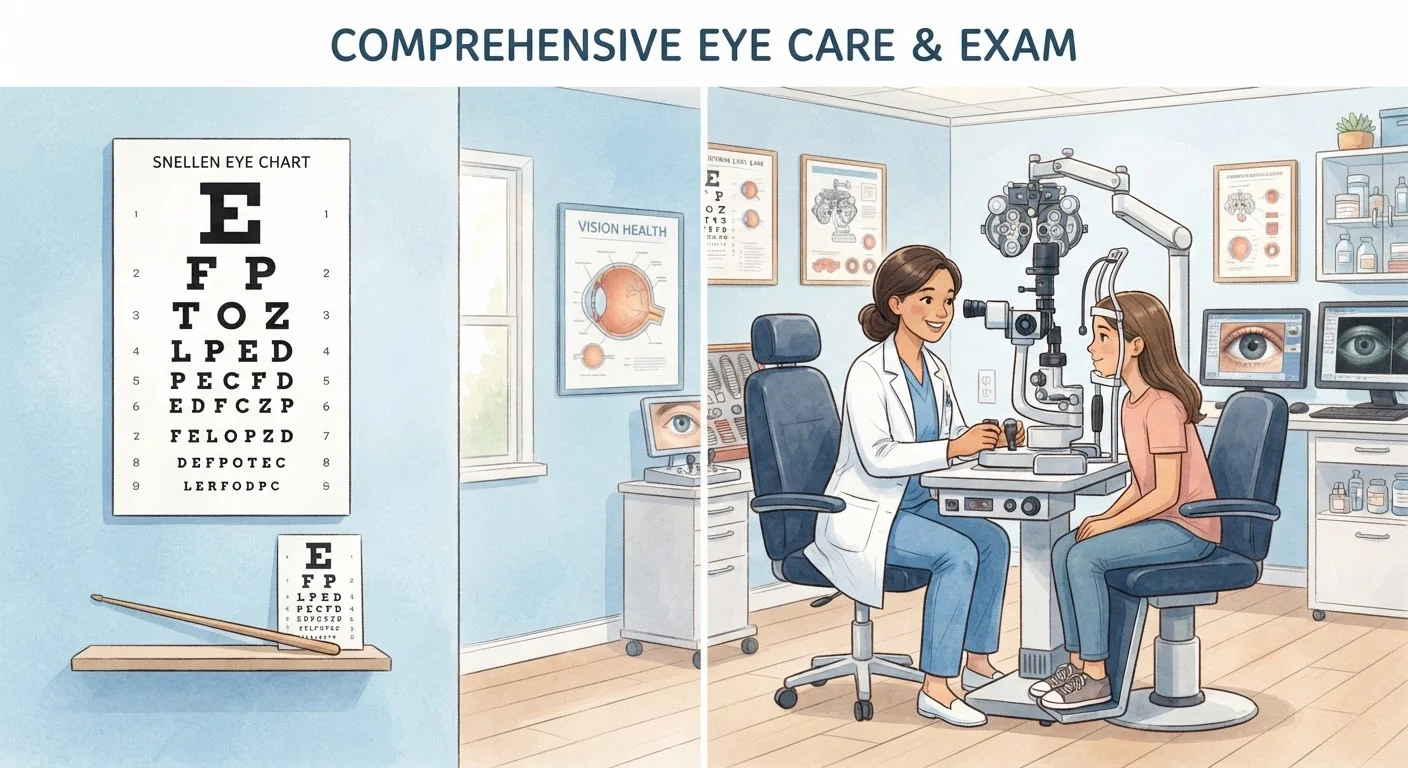
Photo: HerbHealWellness.com | Modern Guide To Wellness editorial
Key Takeaways
- A vision screening only tests how clearly you see at a distance — it is not a diagnostic exam.
- Comprehensive eye exams evaluate the internal and external health of the eye, not just sharpness of vision.
- Many serious eye conditions, including glaucoma and diabetic eye disease, can only be detected through a full exam.
- Passing a school or workplace screening does not mean your eyes are healthy.
- Eye care guidelines generally recommend comprehensive exams every one to two years for most adults.
What Each One Actually Measures
A vision screening is a brief test — often the familiar letter chart — designed to flag whether a person's distance visual acuity falls below a set threshold. It is typically administered by a school nurse, an employer's occupational health team, or a primary care provider. The entire process may take only a few minutes, and the result is binary: pass or refer. It says nothing about the health of the structures inside the eye.
A comprehensive eye exam, performed by an optometrist or ophthalmologist, is a multi-step clinical evaluation. It assesses visual acuity at various distances, determines whether a corrective prescription is needed, and examines the cornea, lens, optic nerve, retina, and surrounding tissues. Techniques such as tonometry (eye pressure measurement), slit-lamp biomicroscopy, and dilated fundus examination allow the clinician to detect disease that has no outward symptoms whatsoever. See what each step of a routine eye exam involves for a detailed walkthrough.
| Criterion | Vision Screening | Comprehensive Eye Exam |
|---|---|---|
| Who administers it | Nurse, technician, or employer | Optometrist or ophthalmologist |
| Time required | 2–5 minutes | 45–90 minutes |
| Tests visual acuity | Yes (distance only) | Yes (distance and near) |
| Detects eye disease | No | Yes |
| Measures eye pressure | No | Yes |
| Examines retina and optic nerve | No | Yes |
| Provides a corrective prescription | No | Yes |
| Detects amblyopia or strabismus | Often misses | Yes |
| Outcome | Pass or referral | Full clinical diagnosis and care plan |
The Critical Gap: What Screenings Miss
The most important misconception in eye care is that passing a screening means your eyes are healthy. In reality, many of the most serious eye conditions develop silently — with no change in how clearly you see until significant, often irreversible, damage has already occurred.
Glaucoma, for example, can destroy peripheral nerve fibers for years before affecting central vision. Diabetic retinopathy, age-related macular degeneration, and hypertensive retinopathy are similarly asymptomatic in their early stages. None of these conditions are detectable through a standard letter-chart screening. As our related coverage explains, serious eye conditions often have no early warning signs — making routine comprehensive exams the only reliable safety net.
For children, the stakes are equally high. Screenings frequently fail to detect amblyopia (commonly called "lazy eye"), strabismus-related suppression, and binocular vision disorders that interfere with reading and learning — all of which respond well to early treatment but are easily overlooked without a proper exam.
~50%
Children with vision problems missed by screenings
Research published in optometry journals has consistently found that school-based screenings fail to identify roughly half of children with clinically significant vision disorders.
3 million
Americans with undiagnosed glaucoma
The Glaucoma Research Foundation estimates that approximately half of the roughly 3 million Americans living with glaucoma are unaware of their condition.
90%
Vision loss from diabetic eye disease that is preventable
According to the CDC, up to 90% of diabetes-related vision loss can be prevented through early detection during routine comprehensive eye exams.
When to Choose One Over the Other
Vision screenings serve a legitimate public health function: they are cost-effective tools for triaging large populations and directing those who fail toward professional care. If a child or employee fails a screening, that is a prompt to schedule a comprehensive exam — not a diagnosis in itself.
For most adults, established eye care guidelines recommend a comprehensive exam every one to two years, with more frequent visits for those over 60, contact lens wearers, or anyone with diabetes, high blood pressure, or a family history of eye disease. Children generally benefit from their first professional eye evaluation before age five, even if they appear to see well. A common barrier is the mistaken belief that current good vision means no exam is necessary — an assumption that eye exam myths reinforce and that can quietly put long-term vision at risk.
This article is for general informational purposes only and does not constitute medical advice. Always consult a qualified eye care professional regarding your specific vision health needs.
The content on this site is for informational purposes only and is not a substitute for professional advice. Always consult a qualified professional for guidance specific to your situation.