
Reading Your Glasses Prescription: A Plain-Language Guide

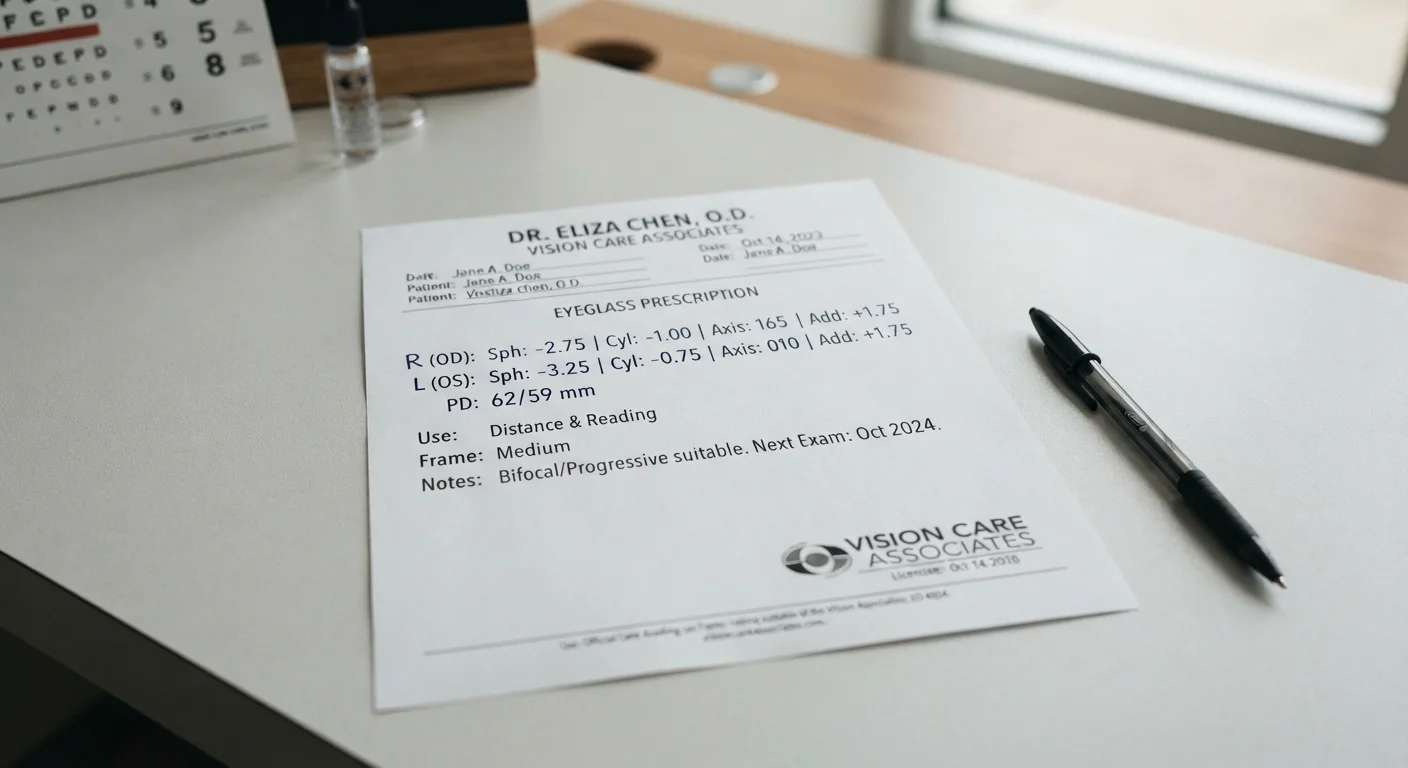
Photo: HerbHealWellness.com | Modern Guide To Wellness editorial
What You're Actually Looking At
After an eye exam, your optometrist or ophthalmologist hands you a slip of paper filled with abbreviations, plus and minus signs, and decimal numbers. It can look cryptic — but each value has a precise, predictable meaning. This guide walks through every field so you can read your prescription with confidence.
Your glasses prescription describes how your lenses must bend light to bring images into focus on your retina. If you're unsure why you need correction in the first place, our article on refractive errors explained covers myopia, hyperopia, astigmatism, and presbyopia in plain language.
| Prescription rows | OD (right eye) and OS (left eye) |
| Power unit | Diopters (D), in 0.25 increments |
| Axis range | 1 to 180 degrees |
| ADD range (typical) | +0.75 to +3.50 D |
| Glasses prescription valid for contacts? | No — a separate contact lens Rx is required |
The Core Abbreviations, Defined
Most prescriptions are organized in two rows — OD (right eye) and OS (left eye) — sometimes followed by a combined OU value. Within each row, you'll typically see these fields:
- SPH (Sphere): The main focusing power of the lens, measured in diopters. A minus sign (−) indicates nearsightedness; a plus sign (+) indicates farsightedness. Values generally range from plano (0.00) to ±20.00, though most prescriptions fall within ±6.00.
- CYL (Cylinder): The power needed to correct astigmatism. If this field is blank or reads "DS" (diopters sphere), you have no significant astigmatism in that eye.
- AXIS: A number from 1 to 180 (degrees) that specifies the orientation of astigmatism correction. It is only meaningful when a CYL value is present.
- ADD: The additional magnifying power added to the bottom of a bifocal or progressive lens, primarily for near vision in people with presbyopia. It is always a positive number, typically between +0.75 and +3.50.
- Prism & Base: Less common. Prism corrects eye alignment problems; the base indicates the direction of the prism. Most prescriptions do not include these fields.
Diopter (D)
The unit used to measure the refractive (focusing) power of a lens. Higher absolute values mean stronger correction is needed.
Sphere (SPH)
The primary lens power that corrects nearsightedness or farsightedness. Negative values correct myopia; positive values correct hyperopia.
Cylinder (CYL)
The additional lens power that corrects astigmatism, representing the difference in curvature between two meridians of the eye.
Axis
A degree value (1–180) indicating the orientation of astigmatism in the eye. It works in conjunction with the CYL value and has no meaning without it.
ADD
The extra magnifying power prescribed for near vision in bifocal or progressive lenses, most commonly used for presbyopia.
OD / OS / OU
Latin abbreviations for right eye (oculus dexter), left eye (oculus sinister), and both eyes (oculus uterque).
Prism
A lens element that shifts the image perceived by one eye to help both eyes work together. Prescribed for certain eye alignment conditions.
Base Curve (BC)
A measurement on contact lens prescriptions describing how the back of the lens curves to match the surface of the cornea.
Reading a Sample Prescription
Consider this example:
| SPH | CYL | AXIS | ADD | |
|---|---|---|---|---|
| OD | −2.50 | −0.75 | 180 | +2.00 |
| OS | −1.75 | −1.25 | 090 | +2.00 |
Translation: both eyes are nearsighted (negative SPH), both have mild astigmatism (negative CYL with an AXIS orientation), and the wearer needs reading help (ADD +2.00), indicating presbyopia. The left eye has slightly more astigmatism than the right.
Prescription Expiration Varies by State
Once you understand your prescription, you can explore how different correction formats work — glasses, contacts, or surgery — in our overview of vision correction choices.
Glasses vs. Contact Lens Prescriptions
A glasses prescription is not automatically transferable to contact lenses. Contact prescriptions include additional measurements:
- BC (Base Curve): The curvature of the lens back surface, matched to your cornea's shape.
- DIA (Diameter): The overall size of the contact lens.
- Brand: Unlike glasses lenses, contact lens power can vary slightly by material and manufacturer, so the brand is specified.
The power values may also differ numerically from your glasses prescription because contacts sit directly on the eye rather than at a distance from it. Always use the prescription your eye care provider wrote specifically for the lens type you intend to wear. For more on how lens categories differ, see our reference on contact lens types.
~45 million
Contact lens wearers in the US
According to the CDC, approximately 45 million Americans wear contact lenses, making prescription literacy especially relevant.
1 in 3
US adults with presbyopia
Presbyopia affects roughly one-third of American adults, making the ADD field one of the most commonly misunderstood parts of a prescription.
This article is for informational purposes only and is not a substitute for professional medical or optometric advice. Consult a licensed eye care provider for guidance specific to your vision needs.
The content on this site is for informational purposes only and is not a substitute for professional advice. Always consult a qualified professional for guidance specific to your situation.