
How Ultrasound Therapy Differs From the Scans Used in Diagnostics

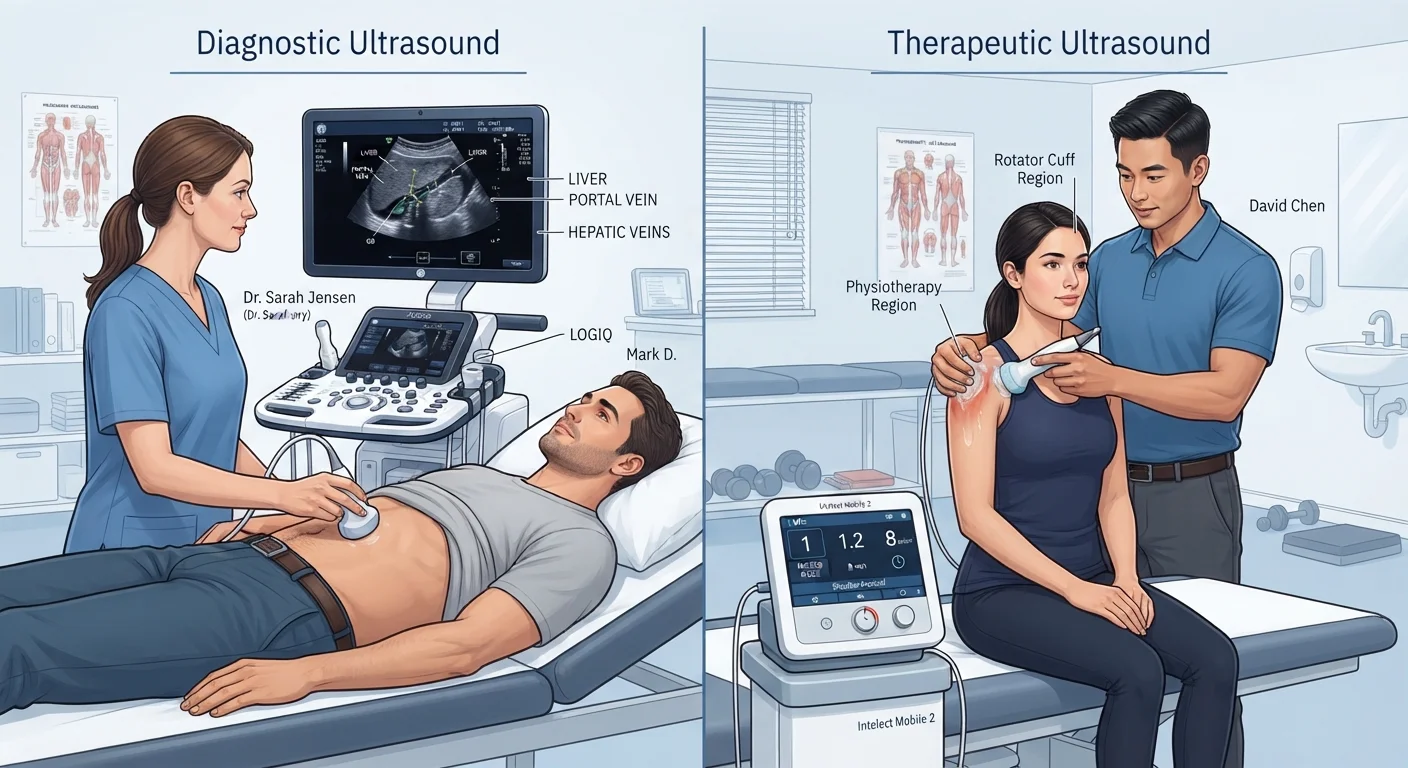
Photo: HerbHealWellness.com | Modern Guide To Wellness editorial
Key Takeaways
- Both technologies use high-frequency sound waves, but serve entirely different clinical purposes.
- Diagnostic ultrasound captures reflected echoes to build images; therapeutic ultrasound deposits energy into tissue.
- Therapeutic ultrasound operates at lower intensities designed to heat or mechanically stimulate tissue, not to visualize it.
- Neither technology uses ionizing radiation, making both generally considered safe when used by trained professionals.
- Therapeutic ultrasound is a physiotherapy modality — it is not a substitute for diagnostic imaging.
The Same Physics, Two Entirely Different Jobs
It is easy to assume that a device called an "ultrasound" in a physiotherapy clinic and the scanner used in a maternity ward must work the same way. Both emit high-frequency sound waves — well above the range of human hearing — and both involve a handheld probe placed against the skin. Beyond those surface similarities, however, the two technologies diverge completely in purpose, frequency, intensity, and clinical outcome.
Diagnostic ultrasound, formally called sonography, sends brief pulses of sound into the body and listens for the echoes that bounce back when waves meet tissue boundaries. A computer translates those echo patterns into real-time images on a monitor. As detailed in our overview of ultrasound in clinical practice, this imaging technique spans far beyond obstetric scans — it guides needle procedures, assesses cardiac function, and evaluates musculoskeletal injuries.
Therapeutic ultrasound does the opposite of imaging. It is designed to not return information to a screen. Instead, it sustains a continuous or pulsed beam of acoustic energy into soft tissue with the deliberate goal of producing biological effects — primarily heat and mechanical agitation at depth.
| Criterion | Diagnostic Ultrasound | Therapeutic Ultrasound |
|---|---|---|
| Primary purpose | Create images of internal structures | Deliver energy to treat soft tissue |
| Typical frequency range | 2–18 MHz | 1–3 MHz |
| Output mode | Short pulses, mostly listening | Continuous or pulsed sustained beam |
| Tissue effect | Negligible heating; echo capture | Deliberate heating or mechanical agitation |
| Clinical setting | Radiology, obstetrics, emergency medicine | Physiotherapy, sports medicine clinics |
| Operator | Sonographer or trained physician | Licensed physiotherapist |
| Uses ionizing radiation | No | No |
| Produces a viewable image | Yes — displayed on monitor | No image produced |
How Each Device Works at the Tissue Level
In diagnostic scanning, the transducer alternates rapidly between transmitting and receiving. Because the emitted energy is low and the listening window is long, almost no meaningful heating occurs. The priority is signal fidelity — preserving enough wave integrity to reconstruct a clear image. Diagnostic probes typically operate between 2 and 18 MHz, with higher frequencies providing sharper resolution at shallower depths.
Therapeutic ultrasound units most commonly operate at 1 MHz or 3 MHz. The 1 MHz frequency penetrates up to 5 centimeters into tissue, making it suitable for larger muscle groups; 3 MHz is absorbed closer to the surface, around 1–2 centimeters, and is often used for tendons and ligaments near the skin. The device is set to deliver a specific intensity — measured in watts per centimeter squared — rather than optimized for echo return. In continuous mode, the constant energy absorption raises local tissue temperature. In pulsed mode, the thermal effect is reduced while mechanical effects — known as acoustic streaming and cavitation — predominate.
1–3 MHz
Therapeutic ultrasound treatment frequencies
The American Physical Therapy Association notes 1 MHz targets deeper tissue up to ~5 cm, while 3 MHz is absorbed within ~2 cm of the surface.
2–18 MHz
Diagnostic ultrasound frequency range
Higher diagnostic frequencies (e.g., 15–18 MHz) yield finer resolution but penetrate only a few millimeters — used for superficial structures like tendons.
~4°C
Target temperature rise in therapeutic application
Research indicates a tissue temperature increase of approximately 4°C is associated with the proposed therapeutic effects of continuous-mode ultrasound.
These mechanical effects are thought to influence cell membrane permeability and promote circulation in the treated area, though clinical evidence for specific outcomes varies by condition. Readers seeking a fuller explanation of what to expect in a session can find one in our plain-language overview of therapeutic ultrasound in physiotherapy.
Safety, Oversight, and When Each Is Used
Neither technology uses ionizing radiation — a meaningful distinction from X-rays or CT scans. For context on how imaging modalities compare more broadly, our article on MRI vs CT scan covers how clinicians weigh imaging choices. Diagnostic ultrasound safety is regulated through guidelines on mechanical and thermal indices displayed on modern scanner screens, and licensed sonographers are trained to keep exposures within established limits.
Therapeutic ultrasound devices used in physiotherapy are operated by licensed professionals who adjust frequency, intensity, and duty cycle based on the target tissue and treatment goal. Incorrect application — such as delivering high-intensity continuous mode over bony surfaces or using the device over areas with impaired sensation — can cause tissue damage. This is why therapeutic ultrasound is a clinic-administered modality, not a self-treatment tool.
It is also worth noting that therapeutic ultrasound is a treatment, not a diagnostic step. It generates no image and provides no structural information about what is happening inside the body. A physiotherapist using it already has a clinical assessment in hand. As our piece on why imaging alone cannot diagnose most conditions explains, even diagnostic scans are one input among many — they do not replace clinical judgment.
Therapeutic Ultrasound Is Not a Home Device
This article is for informational purposes only and is not a substitute for professional medical advice. Always consult a qualified healthcare provider regarding any health concerns or before beginning any therapeutic treatment.
The content on this site is for informational purposes only and is not a substitute for professional advice. Always consult a qualified professional for guidance specific to your situation.